
AI for SEO Article Ranking: Google's First Page
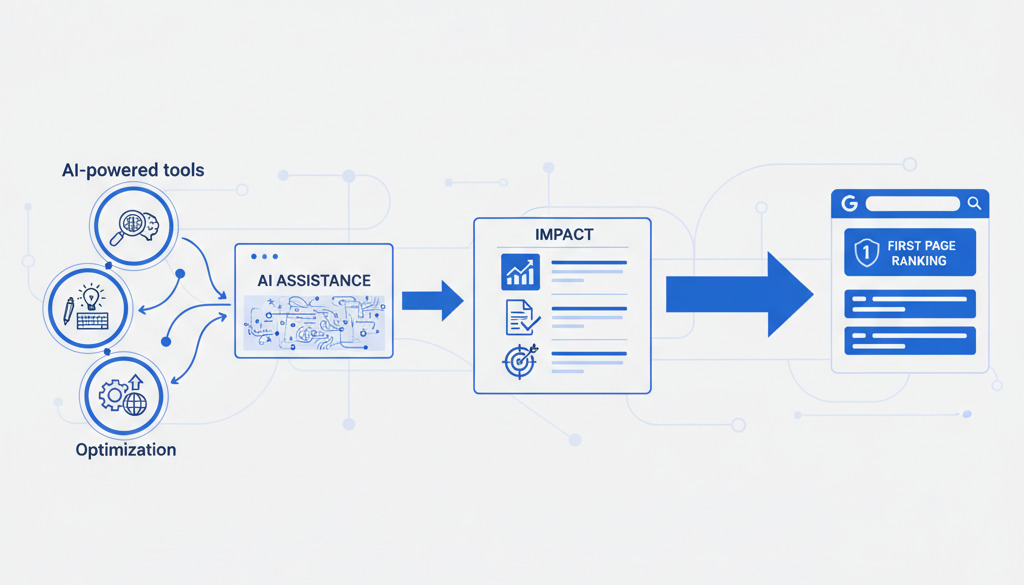
Key Takeaways
- AI is Essential for Modern SEO: With Google's AI Overviews now appearing in nearly 48% of searches, integrating AI is no longer optional for maintaining visibility.
- Comprehensive Content Generation: AI tools can handle the entire content lifecycle, from in-depth keyword research and topic ideation to drafting complete, search-optimized articles.
- Efficiency and Scale for Business Owners: For busy entrepreneurs who lack the time for content creation, AI offers a way to produce high-quality blog posts in minutes, not days, allowing them to compete with larger companies.
- Human Oversight is Crucial: The most successful AI content strategy involves a human-in-the-loop approach. AI generates the draft, and a human editor refines it for brand voice, accuracy, and unique insights.
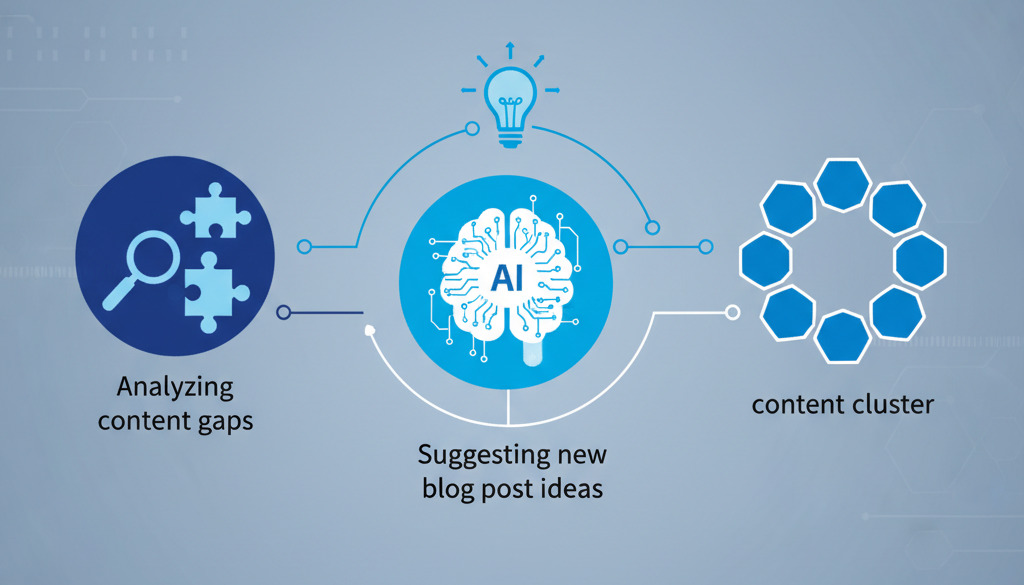
- Focus on Topical Authority: AI excels at identifying content gaps and planning topic clusters, helping your website build authority and rank for a wider range of relevant search terms.
- Proven Results: Businesses leveraging AI for content are seeing tangible benefits, including significant increases in organic traffic, better search rankings, and higher quality leads.
As a business owner, you understand the importance of being visible online. You know that when potential customers search on Google, your website needs to be there, ready to offer a solution. Yet, the reality of running a business often gets in the way. The constant demand for fresh, high-quality blog content feels like a treadmill you don't have the time or energy to run on. It's a common challenge: you know you need consistent SEO articles, but you lack the time, the writing expertise, or simply the desire to do it yourself.
What if you could change that? What if you could have professional, SEO-optimized articles appearing on your blog consistently, attracting customers all on their own? This isn't a far-off dream; it's the new reality powered by Artificial Intelligence. AI is the game-changer for business owners who want to conquer Google search without sacrificing the time needed to run their company. It’s the key to unlocking sustainable growth and ensuring customers find you, not your competitors.
Understanding the Modern SEO Landscape and the Content Imperative
For years, Search Engine Optimization (SEO) has been a cornerstone of digital marketing.[1] Its importance has only grown. Organic search remains one of the most critical channels for acquiring new customers, offering a level of trust and sustainability that paid ads often can't match. However, the ground beneath our feet is shifting rapidly, driven by AI.
The Rise of AI-Driven Search
Google is no longer just a list of blue links. With the introduction of features like **AI Overviews**, the search engine results page (SERP) is transforming. Recent data shows that these AI-powered summaries now appear in approximately 48% of all Google searches. This is a massive increase from just a few months prior, signaling a fundamental change in how users receive information. For businesses, this means the old playbook is no longer enough. You aren't just competing for a top-10 spot; you're competing for a mention in the AI-generated answer itself.
The Unending Need for Quality Content
At the heart of these algorithm changes is a relentless focus on content quality, relevance, and authority. Search engines are smarter than ever at understanding which articles truly satisfy a user's query. They reward content that is comprehensive, well-structured, and demonstrates genuine expertise. The challenge? The sheer volume of content published daily is staggering. For a small or medium-sized business, trying to keep pace manually is an uphill battle, making it nearly impossible to consistently produce the high-caliber articles needed to rank.
The Foundational Role of Articles in SEO Success
While SEO involves many technical aspects, long-form articles remain a primary pillar of any successful strategy. They are the workhorses that drive long-term organic growth, and their value cannot be overstated.
What Makes an Article Rank-Worthy?
A high-ranking SEO article is far more than a collection of keywords. It is a masterclass in value delivery. It must:
- Address User Intent: It needs to directly answer the question or solve the problem the user brought to the search bar.
- Demonstrate Authority: The content must be comprehensive, accurate, and well-researched, establishing your brand as an expert in its field.
- Be Engaging: The article should be easy to read and hold the user's attention, encouraging them to stay on the page.
The Long-Term Benefits of Foundational Content
Investing in high-quality articles pays dividends over time. A single, well-crafted post can attract organic traffic for years, serve as a magnet for backlinks from other websites (a powerful ranking signal), and guide potential customers through their buying journey. These articles become digital assets that appreciate in value, continuously working to bring new business through your door. The primary hurdle for most business owners is the significant upfront investment of time and expertise required to create them.
Introducing Artificial Intelligence: A Transformative Tool for Content Creation
Artificial Intelligence, particularly in the context of content creation, is the solution to the classic business dilemma of having too much to do with too little time. It’s not about robots taking over; it's about leveraging a powerful tool to achieve your goals with unprecedented efficiency.
More Than Just Autocomplete
When we talk about AI for SEO writing, we're referring to sophisticated systems built on Large Language Models (LLMs) and Natural Language Processing (NLP). These models are trained on vast portions of the internet, enabling them to understand context, nuance, tone, and structure. They can analyze data, recognize patterns, and generate human-like text on virtually any subject. For a business owner, this technology acts as a tireless and highly skilled writing assistant.
Augmenting Strategy, Not Replacing It
The smartest way to view AI is as an extension of your own marketing strategy. It doesn’t replace the need for human insight—your unique understanding of your customers and your business. Instead, it handles the heavy lifting of research, outlining, and drafting, freeing you up to focus on the high-level strategy and final polishing that ensures the content perfectly reflects your brand.
AI-Powered Keyword Research and Topic Ideation for Maximum Impact
Every successful SEO article begins with choosing the right keywords and topic. This foundational step determines whether your content will be seen by your target audience or lost in the digital noise. AI revolutionizes this entire process.
Uncovering Hidden Opportunities
Human keyword research is often limited by familiar tools and personal biases. AI, on the other hand, can analyze massive datasets to identify high-intent keywords, emerging trends, and questions your audience is actively asking. It can find underserved niches and long-tail keywords (longer, more specific phrases) that indicate a user is closer to making a purchase. This means attracting more qualified traffic to your site.
Understanding Semantic Relationships
Modern SEO is about more than just one keyword. It's about topics. AI excels at understanding semantic relationships—how different concepts and keywords relate to one another. It can help you build out topic clusters, which are groups of interlinked articles around a central subject. This approach, as detailed in many a strategic blueprint for SEO optimized blog articles, signals to Google that you have deep expertise, leading to better rankings for a wide range of terms.
Leveraging AI for Comprehensive Content Structure and Planning
A great topic is only half the battle. The article itself needs to be structured logically and cover all the key points a reader (and Google) expects to see. This is another area where AI provides a massive competitive advantage.

Analyzing the Competition at Scale
Want to know what it takes to rank for a specific keyword? An AI tool can analyze the top-ranking articles in seconds. It deconstructs their structure, headings, key points, and question-answer formats to create a data-driven blueprint for your own article. This ensures you cover the topic more comprehensively than your competitors.
Generating Detailed Content Outlines
Armed with this analysis, AI can generate a complete content outline, including all the H2 and H3 subheadings needed for a thorough, well-organized post. For a busy business owner, this eliminates hours of painstaking planning. You start with a proven structure, ready to be filled with expert content, ensuring no critical information is missed. This strategic approach is a core component of advanced AI content keyword research and content planning.
AI's Role in Crafting Engaging and Search-Optimized Content
Once the plan is in place, it's time to write. AI has become incredibly proficient at generating high-quality, human-like text that is optimized for both readers and search engines from the outset.
From Blank Page to First Draft in Minutes
The most time-consuming part of content creation is the initial drafting. AI can take a detailed outline and produce a complete, well-written first draft in a matter of minutes. This draft will naturally incorporate target keywords, adhere to a specified tone of voice, and be structured for maximum readability. The writer’s block that plagues so many business owners becomes a thing of the past.
Writing for User Intent
Because AI can analyze top-ranking content, it learns what a search engine like Google believes is the best answer to a query. Therefore, the content it generates is laser-focused on addressing user intent. It directly answers questions, provides solutions, and delivers the value that users are seeking. This is a critical ranking factor in modern SEO, as it leads to higher engagement and signals to Google that your page is a quality result.
The "Almost Like Magic" Effect: Rapid Article Generation with Advanced AI
For the time-strapped business owner, the speed of advanced AI content platforms can feel almost like magic. The idea of turning a content need into a polished, professional SEO article in minutes is a powerful proposition.
The Power of Specialized Platforms
While general-purpose AI writers are useful, specialized platforms designed for SEO article creation offer the greatest efficiency. These systems are fine-tuned for this specific task, integrating keyword research, competitive analysis, drafting, and optimization into a seamless workflow. They are built to produce content that is not just readable, but designed from the ground up to rank on search engines.
A Solution for Busy Entrepreneurs
This level of automation is transformative. It levels the playing field, allowing small and medium-sized businesses to maintain a robust and effective content strategy without hiring a large team. This is the core promise of services that help you get **more customers from your blog**; they use their proprietary AI technology to deliver professional articles with unrivaled speed and quality, turning a major business challenge into a simple, automated process.
Ensuring Quality and Accuracy: The Human-AI Collaboration Model
With all the talk of automation and speed, it's natural to worry about quality. Can a machine truly create content that reflects your brand and connects with your audience? The key lies in collaboration, not full abdication.
Addressing AI's Limitations
AI-generated content is an incredible starting point, but it is not infallible. It can sometimes lack a unique brand voice, miss subtle industry nuances, or, in rare cases, make factual errors. This is why a "human-in-the-loop" approach is essential for producing top-tier content. The AI acts as a co-pilot, not the pilot.
The Power of Human Refinement
The ideal workflow involves AI generating the first 80-90% of the article. A human expert—you or a skilled editor—then comes in to perform the crucial final 10-20%. This includes:
- Fact-checking and adding specific data.
- Injecting personal anecdotes or company case studies.
- Refining the tone to perfectly match your brand voice.
- Ensuring the content provides unique insights not found elsewhere.
This collaborative model delivers the best of both worlds: the speed and scale of AI combined with the nuance and strategic oversight of a human expert.
Optimizing for Readability and User Experience with AI Assistance
Ranking on Google isn't just about what you say; it's about how you say it. If your content is a dense, unreadable wall of text, users will leave, and Google will notice. AI is an invaluable tool for enhancing readability and user experience.
Improving Sentence and Paragraph Structure
AI tools can analyze your content and score its readability. They can suggest breaking up long, complex sentences, shortening paragraphs, and replacing jargon with clearer language. This ensures your message is accessible to the widest possible audience, which is especially important when your customers may not be experts in your field.
Enhancing User Engagement Metrics
A more readable article leads directly to better user engagement. When visitors find your content easy to digest, they are more likely to stay on the page longer and have a lower bounce rate (leaving after viewing only one page). These are strong positive signals to Google that your page is a high-quality result, which can indirectly boost your search rankings over time.
AI for On-Page SEO Elements Beyond the Body Content
A successful SEO article requires more than just a great body of text. Several other on-page elements play a critical role in how your page is perceived by search engines and users. AI can automate and optimize these components as well.
Crafting Click-Worthy Meta Data
Your meta title and meta description are your sales pitch on the search results page. They need to be compelling enough to entice a user to click on your link instead of a competitor's. AI can generate multiple variations of titles and descriptions, optimized for length and keyword inclusion, allowing you to choose the one most likely to attract clicks.
Optimizing Images and URLs
AI can also assist with often-overlooked details like image alt text. Alt text describes an image for visually impaired users and search engine crawlers, providing additional context and a chance to include relevant keywords. Furthermore, AI can suggest clean, keyword-rich URL slugs (the part of the URL that identifies a specific page), which contributes to a better user experience and stronger SEO.
The Power of AI in Content Clustering and Topical Authority
To truly dominate a niche in search results, you can't rely on a single article. You must build "topical authority," which means demonstrating comprehensive expertise on a subject. AI is instrumental in achieving this at scale.
What is Topical Authority?
Topical authority is a signal you send to Google that your website is a definitive source of information on a particular topic. You build it by creating a "cluster" of content—one central "pillar" page covering a broad topic, linked to and from multiple "cluster" pages that cover related subtopics in greater detail. For example, a pillar page on "Small Business Accounting" could link to cluster pages on "Choosing Accounting Software," "Understanding Business Tax Deductions," and "How to Read a Profit & Loss Statement."
Using AI to Build Your Content Hub
Manually planning a topic cluster is a complex strategic exercise. AI simplifies it dramatically. It can analyze your existing content to identify your current areas of strength and, more importantly, find the "gaps." It will suggest new article topics that would perfectly complement your existing posts, helping you strategically build out a complete content hub. This systematic approach is a powerful way to solidify your expertise and rank for a huge number of related search queries.
Measuring the Impact: AI-Assisted SEO Performance Analysis
Creating content is just one part of the equation. You also need to know if it
AI for SEO Article Ranking: Navigating Google's First Page
Achieving a prominent position on Google's first page is the ultimate goal for any content creator or marketer. The competition is fierce, with countless websites vying for visibility. While strong content and a robust backlink profile remain foundational, the role of Artificial Intelligence (AI) in optimizing content for higher rankings is becoming increasingly undeniable. AI-powered tools are no longer just helpful; they are becoming essential for deciphering the intricate algorithms that dictate search engine results pages (SERPs). Understanding how AI influences these algorithms and how to leverage AI to enhance your articles' ranking potential is crucial for staying ahead in the digital landscape.
Google itself is heavily reliant on AI to understand and rank content. Algorithms like RankBrain and BERT are sophisticated AI systems designed to interpret the nuances of search queries and the content intended to answer them. RankBrain, for instance, helps Google better understand ambiguous or never-before-seen search queries, correlating them with existing ones and identifying the most relevant results. BERT (Bidirectional Encoder Representations from Transformers) goes even further, understanding the context of words in a sentence, which is vital for natural language processing and, consequently, for matching user intent with the best possible content. When these AI systems process search queries, they are essentially looking for signals of authority, relevance, and user satisfaction. AI can help content creators proactively identify and integrate these signals into their articles before they are even published. This involves analyzing competitor content, identifying semantic gaps, and ensuring that the language used within an article aligns perfectly with how users are actually searching for information.
Leveraging AI for article ranking involves a multi-faceted approach. Firstly, AI-driven keyword research tools can move beyond simple volume metrics to identify long-tail keywords with high user intent and lower competition. These tools can analyze search trends, predict emerging topics, and even suggest semantically related terms that might not be immediately obvious. This allows for the creation of highly targeted content that directly addresses specific user needs. Secondly, AI can assist in content optimization by analyzing existing content and suggesting improvements to on-page elements such as headings, meta descriptions, and internal linking structures. AI tools can also assess content readability, tone, and grammatical accuracy, ensuring that the final piece is not only keyword-rich but also engaging and easily digestible for human readers. This holistic approach, driven by AI insights, significantly increases the chances of an article resonating with both users and search engine algorithms, ultimately leading to improved rankings on Google's first page.
Predictive SEO and Trend Analysis with AI
The landscape of search is constantly evolving, driven by user behavior shifts and algorithmic updates. AI excels at identifying these shifts long before they become mainstream trends. By analyzing vast datasets of search queries, content performance metrics, and social media discussions, AI can predict emerging topics and keywords with remarkable accuracy. This predictive capability allows content creators to be proactive rather than reactive. Instead of chasing after popular topics, they can begin developing authoritative content around them before the competition even recognizes their potential. Imagine being able to anticipate the next big "how-to" trend in your industry or the emerging concerns of your target audience. AI-powered trend analysis tools can provide these insights, enabling you to create evergreen content that remains relevant and rankable for an extended period.
Furthermore, AI can help in understanding the lifespan and potential of different types of content. Not all topics have the same search trajectory. Some are evergreen, maintaining consistent interest over time, while others are seasonal or trend-driven, experiencing sharp peaks and rapid declines. AI can analyze historical data to forecast these patterns, guiding your content strategy to maximize impact. For instance, an AI might identify that while a certain trending topic can generate significant short-term traffic, investing in foundational content for a more evergreen subject will yield more sustainable long-term SEO benefits. This nuanced understanding, powered by AI's analytical prowess, is invaluable for allocating resources effectively and building a content library that consistently contributes to your website's authority and search visibility. This forward-thinking approach is a cornerstone of modern AI-driven SEO, moving beyond historical data to anticipate future search demands.
Leveraging AI for Enhanced Google First Page Ranking
Achieving a coveted spot on Google's first page requires a sophisticated understanding of search engine algorithms and user intent. In this landscape, Artificial Intelligence (AI) is not merely a tool for content creation; it's a powerful engine for optimizing entire articles to meet and exceed Google's ranking criteria. AI-driven SEO article ranking strategies focus on deeply analyzing the factors that contribute to a page's authority, relevance, and user experience, all of which are paramount for first-page visibility. Google's algorithms are constantly evolving, prioritizing content that not only answers user queries effectively but also demonstrates E-E-A-T (Experience, Expertise, Authoritativeness, Trustworthiness). AI excels at dissecting vast amounts of data to identify patterns and correlations that humans might miss, enabling content creators and SEO professionals to fine-tune their articles with unprecedented precision. This includes everything from identifying the optimal keyword density and semantic variations to understanding the subtle nuances of user engagement signals like dwell time and bounce rate. By harnessing AI, you can move beyond generic SEO advice and implement data-backed strategies tailored to your specific niche and target audience, significantly increasing your chances of ranking higher.
One of the most significant contributions of AI to article ranking is its ability to perform hyper-granular competitive analysis. Traditional SEO often involves looking at the top-ranking pages for a given keyword and identifying commonalities. However, AI can go much deeper, analyzing not just the on-page content but also the backlink profiles, the loading speed of competitor pages, the user experience metrics they achieve (where available), and even the sentiment expressed in their associated online discussions. This advanced analysis allows for the identification of specific content gaps and opportunities that are not readily apparent. For instance, an AI might identify that while several articles rank for a particular query, none adequately address a specific sub-topic or provide a unique perspective, creating an opening for your content. Furthermore, AI can predict how Google's algorithm might interpret certain content structures or linguistic patterns, allowing for proactive optimization. It can also assess the readability and clarity of your content compared to competitors, ensuring that your message is not only comprehensive but also easily digestible for the target audience. This comprehensive understanding empowers you to craft articles that are not only factually accurate and informative but also strategically positioned to outrank the competition on Google's first page through a data-driven, AI-informed approach.
Predictive Optimization for Algorithm Shifts
Google's algorithms are notoriously opaque and frequently updated, posing a continuous challenge for SEO professionals. AI offers a proactive solution by analyzing historical algorithm update patterns, search trend shifts, and emerging user behavior to predict potential future ranking factors. This predictive capability allows for the development of content and optimization strategies that are more resilient to algorithm changes. Instead of reacting to a Google update, AI-informed SEO aims to anticipate its implications. For example, if AI models detect a growing emphasis on conversational search queries or a shift towards more visual content integration within search results, content creators can begin adapting their strategy accordingly. This might involve refactoring content for voice search optimization, incorporating more relevant images and videos, or structuring articles to better answer direct questions. By understanding the underlying principles that guide Google's algorithm evolution, AI can help ensure that your articles remain relevant and rankable, even as the search landscape transforms. This foresight is crucial for maintaining long-term SEO success and securing a consistent presence on the first page of Google, transforming SEO from a reactive discipline into a predictive science.
FAQ
How can AI improve my article’s SEO ranking?
AI can enhance your article's SEO by analyzing vast amounts of data to identify high-performing keywords, optimize content structure for readability, and even predict user search intent. It helps create content that is more relevant and valuable to both search engines and your target audience.
Will AI replace human SEO professionals for article ranking?
While AI tools are becoming incredibly powerful for SEO tasks, they are unlikely to completely replace human SEO professionals. AI excels at data analysis and automation, but human expertise is still crucial for strategic thinking, creativity, ethical considerations, and understanding nuanced market trends.
What are the risks of relying solely on AI for SEO article ranking?
Over-reliance on AI without human oversight can lead to generic or uninspired content that doesn't truly connect with readers. There's also a risk of adhering too rigidly to AI suggestions that may not grasp the unique voice or specific objectives of your brand, potentially missing opportunities for genuine audience engagement.
Keep reading
Hand-picked guides that go deeper — open the one you need next:
- AI drives 3x organic traffic growth: Volteruno explained
- Advanced AI SEO Content: Beyond Keywords
- No Technical Knowledge Needed: Easy SEO with Volteruno
- Organic Traffic Growth: AI for Page 1 on Google