
Shopify Blog SEO: Driving Buyer Traffic with Volteruno

Key Takeaways
- Effortless Content Creation: AI tools can write professional, SEO-optimized blog posts for your Shopify store in minutes, solving the problem of time and resource constraints for busy business owners.
- Drive Buyer-Intent Traffic: A strategic blog powered by AI attracts customers who are actively searching on Google for products and solutions like yours, leading to higher-quality leads and sales.
- Human Oversight is Crucial: While AI is powerful, the best results come from a hybrid approach. Human review is essential for fact-checking, brand voice alignment, and adding unique personality.
- SEO is More Than Keywords: Modern Shopify SEO involves understanding user intent, creating topic clusters, and building authority, all of which AI can significantly assist with.
- Measure and Refine: Use tools like Google Analytics to track your blog's performance. Data on traffic, rankings, and conversions will help you improve your AI content strategy over time.
- Low-Risk to Start: With services offering free initial posts, you can test the power of AI content generation for your business without any upfront investment.
The Untapped Power of Your Shopify Blog for Customer Acquisition
You know your business needs to be more visible online. You've heard about "content marketing" and "SEO," and you understand, in principle, that having a blog on your Shopify store is important.[1] But the reality is you're a business owner, not a professional writer. You have products to manage, orders to fulfill, and a business to run. The idea of finding time to research, write, edit, and optimize blog posts feels overwhelming, if not impossible. This is a common and completely understandable challenge for entrepreneurs.
For decades, content marketing has been a game of trade-offs. You could either invest countless hours you don't have, hire expensive writers or agencies, or simply let your blog gather dust. Inconsistency becomes the norm, and the potential for attracting new customers through Google searches remains an untapped goldmine.
But what if there was a way to change that equation entirely? Imagine being able to generate high-quality, SEO-focused blog content in minutes, not days. This is the promise of leveraging Artificial Intelligence (AI) for your Shopify blog—it’s a genuine game-changer for business owners who are short on time but have big ambitions. This article will be your comprehensive guide to understanding and implementing AI-powered content creation, turning your Shopify blog into a powerful engine for organic traffic and customer growth, all with minimal effort and no technical expertise required.
Why Your Shopify Store Needs a Blog: Beyond Just Product Descriptions
Your product pages are for selling, but your blog is for connecting, educating, and building trust. A well-maintained blog is one of the most powerful assets for an e-commerce business, serving as the foundation for sustainable, long-term growth.
Building Authority and Trust
Why should a customer buy from you instead of a competitor? A blog helps you answer that question. By publishing informative articles that solve your customers' problems, answer their questions, and address their pain points, you establish your brand as a knowledgeable leader in your niche. This authority builds an immense amount of trust, making customers more confident in their decision to purchase from you.
Driving High-Quality Organic Traffic
Think of each blog post as a new "door" to your store from Google. While your product pages might rank for specific product names, a blog can capture traffic from a much wider net of informational queries. Someone searching for "how to choose the right hiking boots" is a potential customer for your outdoor gear store. A blog post answering that exact question can draw them in, long before they're ready to type a brand name into the search bar. This is what we call buyer-intent traffic—visitors who are actively in the research phase of their purchasing journey.
Connecting with Customers
A blog gives your brand a voice and personality. It's a space to share your story, your values, and your expertise. This creates a human connection that is difficult to achieve with product listings alone. Customers who feel connected to a brand are more likely to become repeat buyers and brand advocates.
The SEO Landscape for Shopify Businesses: Understanding the Basics
Search Engine Optimization (SEO) can sound like a complex, technical field, but the core concepts are straightforward. Understanding them is crucial, as it forms the "why" behind your blogging strategy. For Shopify store owners, SEO is the practice of making your store and its content more attractive to search engines like Google.
Keywords: The Language of Your Customers
Keywords are the words and phrases people type into Google. The foundation of good SEO is identifying the keywords your ideal customers are using and creating content around them. They can be short, like "men's shoes," or long-tail, like "best waterproof running shoes for flat feet." The latter are often more valuable as they indicate a clearer, more specific need.
On-Page SEO: Setting Up Your Content for Success
On-page SEO refers to optimizing the elements on the page itself. This includes your article's title, its headings (H2, H3, etc.), the body text, and your meta description (the short summary that appears in search results). Ensuring your main keyword appears naturally in these key places helps Google understand what your page is about.
User Intent: The "Why" Behind the Search
Modern SEO has moved beyond simply matching keywords. Google's primary goal is to satisfy user intent. Are they looking to buy something (transactional intent), learn something (informational intent), or find a specific website (navigational intent)? Your blog is perfect for capturing informational intent, guiding users from learning to buying.
As Shopify's own guidance suggests, old tactics like obsessing over keyword density are outdated. The focus is now on creating high-quality, relevant content that genuinely satisfies the searcher's query.
The Traditional Content Creation Hurdle for Business Owners
If blogging is so beneficial, why do so many Shopify stores have neglected blogs? The reason is simple: traditional content creation is a significant hurdle for busy entrepreneurs. The resources required often feel out of reach for small to medium-sized businesses.
The Massive Time Commitment
Good content takes time. A single, well-researched blog post can easily take 4-8 hours to create. This includes topic research, keyword analysis, outlining, writing, finding images, editing, and final on-page SEO optimization. For a business owner juggling a dozen other responsibilities, dedicating a full day to one blog post is an untenable luxury.
The Expertise and Skill Gap
Being an expert in your field doesn't automatically make you an expert writer or SEO specialist. Effective blogging requires a unique blend of skills: strong writing and storytelling, a deep understanding of SEO principles, and a knack for marketing. Most business owners excel in their own domain but don't have the time or desire to master these additional disciplines.
The Escalating Costs of Outsourcing
The logical next step is to hire someone. However, the costs add up quickly. Hiring a quality freelance writer can cost anywhere from $150 to $500+ per article. Engaging an SEO and content agency can run into thousands of dollars per month. For many businesses, this level of marketing spend isn't feasible, especially when the ROI isn't immediate.
Enter AI: A New Era of Content Creation for Your Shopify Blog
For years, the hurdles of time, cost, and skill have made consistent blogging a distant goal for many. But a technological shift is changing everything. Artificial intelligence is now automating and simplifying the content creation process, making it accessible to everyone, regardless of their budget or schedule.
What is AI Content Generation?
In simple terms, AI content generation tools use massive language models, trained on billions of data points from the internet, to understand and create human-like text. You provide a prompt or a topic, and the AI generates a structured, coherent article in response. It’s like having a highly trained writing assistant on call 24/7.
How AI Solves the Content Hurdles
AI directly addresses the traditional challenges. The time commitment shrinks from hours to minutes. The skill gap is bridged, as the AI handles the heavy lifting of writing and structuring the content. And the cost is a fraction of hiring human writers, making it incredibly cost-effective. Recent data from Shopify indicates that a staggering 75% of established business owners are already using AI tools, with content generation being the number one application. If you're not, you're falling behind.
It’s About Gaining an Edge
Think of AI not as a replacement for human thought, but as a powerful tool for execution—an "invisible assistant," as some have called it. It automates the repetitive tasks of writing, allowing you to focus your valuable time on strategy and growing your business. The end goal isn't just to use fancy technology; it's to get more customers.
Understanding AI-Powered SEO Content: It's Not Just About Writing Fast
The true power of AI in this context isn't just its speed, but its ability to be a formidable SEO tool. Modern AI platforms are designed with search engine visibility in mind, helping you create content that is not only well-written but also primed to rank on Google.
AI's Strengths in SEO Research
Sophisticated AI tools don't just write; they analyze. They can process vast amounts of search data to identify trending topics, understand common customer questions (the "People Also Ask" on Google), and dissect what makes top-ranking articles successful. This allows you to base your content strategy on data, not guesswork.
Natural Keyword Integration
Gone are the days of "keyword stuffing." Google penalizes content that unnaturally crams in keywords. AI can be instructed to weave your target keywords and related phrases (semantic SEO) into the text in a natural, reader-friendly way, which is exactly what modern search algorithms reward.
Perfecting Content Structure for Readability and SEO
AI excels at creating well-structured articles. It can instantly generate outlines with logical H2 and H3 headings, use bullet points and numbered lists to break up text, and ensure the content flows in a way that is easy for both humans to read and search engines to crawl. This structure is a critical component of on-page SEO.
The Crucial Role of the Human Touch
Even the most advanced AI is a tool, not a strategist. The best AI-generated content serves as an 80-90% complete draft. It still requires your expert human touch to add personal anecdotes, verify facts, refine the brand voice, and ensure the final piece offers unique value. AI provides the foundation; you provide the soul.
Choosing the Right AI Content Tool for Your Shopify Blog: Key Considerations
The market for AI tools has exploded, and choosing the right one can feel daunting. For a busy Shopify owner who isn't a tech expert, the key is to focus on simplicity, effectiveness, and features that directly contribute to your business goals.
Key Features Comparison for Shopify Owners
When evaluating options, consider how they stack up in the areas that matter most to you. Here’s a comparative look:
| Feature | Why It Matters | What to Look For |
|---|---|---|
| Ease of Use | You don't have time for a steep learning curve. The tool should be intuitive from the moment you log in. | A clean, simple interface. Clear instructions and minimal jargon. |
| SEO Focus | The goal is traffic from Google, so the tool must be built for SEO, not just general writing. | Features for keyword research, SERP analysis, and on-page optimization guidance. |
| Content Quality | The output must be fluent, coherent, and professional, requiring minimal editing. | Look for tools that produce well-structured, factually sound (with verification) drafts. |
| Specialization | A general AI writer is a jack-of-all-trades. A specialized tool understands the specific goal of creating buyer-intent blog content. | Services designed specifically for SEO blog content for businesses. |
General vs. Specialized Tools
General-purpose AI writers are powerful, but they often require significant "prompt engineering" (giving the AI very detailed instructions) to produce SEO-ready content. For a business owner, a specialized service that handles the SEO complexity behind the scenes is often a more efficient and effective choice.
The "Almost Magical" Power of Volteruno's AI Content Solution
While many AI tools offer general writing capabilities, some solutions are built from the ground up with one specific goal in mind: helping busy business owners get more customers from their blog. Volteruno is one such specialized solution, designed to remove every bit of friction from the content creation process.
Its approach is refreshingly direct. The core premise is that business owners shouldn't have to become SEO experts to get results. Its proprietary artificial intelligence is engineered to write professional SEO blog articles for your website in minutes. The process feels "almost like magic" because it bypasses the complex steps that bog down most users. You provide the topic, and Volteruno delivers an article crafted to attract the right kind of customers—those who find you on their own through Google.
This isn't an unproven concept. The credibility is backed by strong social proof: more than 500 companies already use it to power their content marketing and drive organic growth. It’s a solution born from the exact pain points of time-strapped entrepreneurs, delivering tangible results without the steep learning curve.
Crafting a Stellar AI-Assisted Shopify Blog Content Strategy
Using AI doesn't mean you can abandon strategy. In fact, AI makes it easier to execute a powerful strategy. Before you start generating articles, take a moment to lay the groundwork for success.
Set Clear Goals
What do you want to achieve? Your primary goal is likely to increase traffic and sales. But you can set more specific goals, such as: "Increase organic blog traffic by 20% in the next quarter," or "Rank on the first page of Google for five key informational keywords." Clear goals will help you measure success.
Refine Your Audience Persona
You know your customers better than anyone. Before writing, jot down who your ideal customer is. What are their biggest problems? What questions do they ask? What are their interests related to your products? This "persona" will guide the AI in creating content that truly resonates.
Adopt the Topic Cluster Approach
To establish authority, don't just write random articles. Create "topic clusters." This involves choosing a broad "pillar" topic (e.g., "Beginner's Guide to Skincare") and then creating multiple, more specific "cluster" articles that link back to it (e.g., "How to Choose a Cleanser," "The Importance of Sunscreen," "Morning vs. Night Routines"). This structure tells Google you are an expert on that subject.
Plan a Simple Content Calendar
Even with AI's speed, a plan keeps you consistent. A simple content calendar—a spreadsheet listing the topics you’ll publish each week—ensures your blog remains active. Consistency is a key signal to search engines that your site is a fresh and relevant source of information.
Generating Your First AI-Powered Shopify Blog Posts: A Step-by-Step Guide
This is where the theory becomes reality. Creating your first post with an AI tool is a straightforward process. Let's walk through it.
Step 1: Topic Selection and Keyword Research
Start with a question your customers ask. For example, if you sell coffee, a great topic is "how to make the best cold brew at home." Use a free tool like Google Keyword Planner or simply type your idea into Google and look at the "People Also Ask" section for inspiration.
Step 2: Provide a Clear Prompt to the AI
A good prompt is key. Instead of just "write about cold brew," give the AI more direction. A better prompt would be: "Write a comprehensive guide for beginners on how to make the best cold brew coffee at home. Include a step-by-step recipe, tips on choosing the right beans, and common mistakes to avoid. The target audience is coffee enthusiasts who have never made cold brew before."
Step 3: Generate the Content
This is the easy part. You input your prompt, and the AI tool will generate a full article, complete with a title, introduction, headings, and conclusion, in just a few minutes. Services like Volteruno make this exceptionally simple and even offer a compelling way to start: your first 5 posts are free. This allows you to experience the entire process and see the quality of the output without any risk.
Step 4: The Essential Review and Refinement
Read through the generated draft. Does it flow well? Is the tone right for your brand? Are there any facts that need checking? Spend 15-20 minutes adding your personal touch—perhaps a mention of which of your coffee beans you recommend for cold brew. This small investment of time elevates the content from good to great.
Beyond the First Draft: Optimizing AI Content for Maximum Shopify SEO Impact
Generating the article is the first half of the equation. The second half is ensuring it’s perfectly optimized to be found on Google and to guide readers toward a purchase. This is the crucial final polish that turns content into a sales-driving asset.
Conduct an On-Page SEO Check
Go through this simple checklist for every post:
- SEO Title: Is it compelling and under 60 characters? Does it contain your main keyword?
- Meta Description: Is it an engaging summary under 160 characters? Does it make you want to click?
- Headings: Are your H2s and H3s logical and descriptive? Do they include relevant keywords?
- URL Slug: Is the URL short, clean, and keyword-rich (e.g., /how-to-make-cold-brew)?
Incorporate Internal and External Links
Internal links are hyperlinks to other pages on your site. In your cold brew article, you should link to your product page for coffee beans or cold brew makers. This passes "SEO authority" around your site and keeps visitors engaged. Also, include one or two external links to high-authority, non-competing websites (like a study on caffeine or a major coffee publication) to show Google your content is well-researched.
Optimize Your Images
A blog post with images is far more engaging. Before uploading, make sure your image files are compressed to ensure fast page load times. Most importantly, fill out the "alt text" for each image with a simple, descriptive phrase (e.g., "A glass of homemade cold brew coffee on a wooden table"). Alt text helps Google understand the image content and is crucial for accessibility.
Add a Clear Call to Action (CTA)
Don't leave your reader hanging. At the end of the post, tell them what to do next. Your CTA could be something like: "Ready to make your own? Shop our recommended Cold Brew Coffee Beans today!" or "Sign up for our newsletter for more coffee tips and exclusive discounts."
Human Oversight: The Indispensable Element for AI-Generated Content
The biggest mistake newcomers make with AI content is treating it as a "one-and-done" solution. AI is a remarkably powerful assistant, but it is not a replacement for your human expertise and judgment. This final human touch is what separates generic content from content that truly performs.
Fact-Checking and Accuracy
AI models, while knowledgeable, can occasionally "hallucinate" or present information that is outdated or incorrect. It is your absolute responsibility to fact-check any claims, statistics, or technical details in the generated content. If your article gives bad advice, it reflects poorly on your brand, not the AI.
Injecting Brand Voice and Personality
The AI can write in a professional, friendly, or witty tone, but it can't capture the unique voice of your brand. Your review is where you inject that personality. Add a short personal story, a specific customer example, or phrase things in the way you would speak to a customer in your store. This makes the content authentically yours.
Adding Unique Insights and Anecdotes
What does the AI not know? It doesn't know about the time a customer shared a brilliant tip, or the common mistake you see beginners make over and over. Adding these unique, experience-based insights provides immense value and is something your competitors can't easily replicate.
Your goal is to transform the 90% complete AI draft into a 100% polished, trustworthy, and unique asset for your brand. This final 10% of human effort delivers 90% of the long-term value.
Integrating Your AI-Generated Shopify Blog Content into Your Marketing Funnel
A blog post shouldn't exist in a vacuum. To maximize its value, you need to integrate it into your broader marketing efforts. Think of each article as a versatile tool that can attract, engage, and convert customers at different stages of their journey.
Content Distribution and Promotion
Don't just publish and pray. Once your blog post is live, share it! Post it on your business's social media channels (Facebook, Instagram, Pinterest, LinkedIn). Send it out to your email newsletter list. If you have a marketing budget, you can even run targeted ads to your blog post to attract a relevant audience.
Powering Your Lead Magnets
Your blog content is the perfect place to promote "lead magnets"—valuable freebies you offer in exchange for an email address. For example, a blog post on "10 Ways to Organize Your Kitchen" could offer a "Free Printable Kitchen Organization Checklist" to readers who sign up for your newsletter. This turns blog traffic into a tangible list of potential customers.
Nurturing and Retaining Existing Customers
Your blog isn't just for new customers. It's a powerful tool for customer retention. By consistently providing useful tips, guides, and inspiration, you give existing customers a reason to keep coming back to your site. This builds loyalty and encourages repeat purchases, increasing customer lifetime value.
Seamlessly Connecting Content to Commerce
The ultimate goal is to guide readers from your blog to your products. This should be done naturally. Within your article on making cold brew, you can smoothly transition to a section that says, "For the richest, smoothest flavor, the quality of the beans is paramount. Our team has found that medium roast, coarsely ground beans like our [Product Name] offer the perfect profile for cold brew." This is helpful, not pushy, and provides a direct path to purchase.
Measuring Success: Tracking the ROI of Your AI-Powered Shopify Blog
One of the best things about digital marketing is that everything is measurable. You don't have to guess whether your AI-powered blog is working. By tracking a few key metrics, you can see the direct impact on your business and make data-driven decisions to improve your strategy.
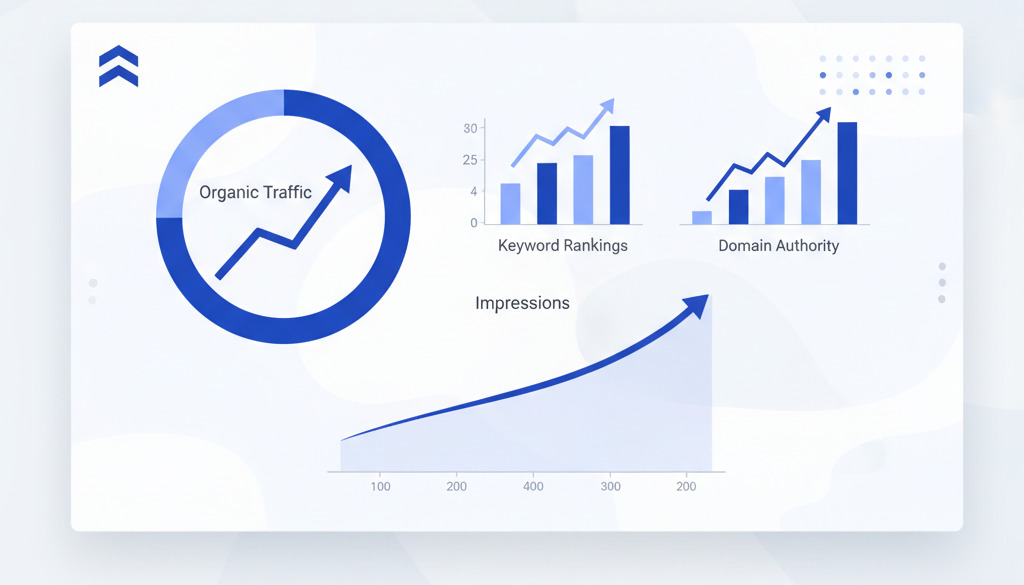
Key Performance Indicators (KPIs) to Watch
- Organic Traffic: The number of visitors arriving at your blog from search engines. This is your primary indicator of SEO success.
- Keyword Rankings: Where your articles appear in Google search results for your target keywords. Are you moving up from page 3 to page 1?
- Time on Page: How long visitors are spending reading your articles. Longer times suggest your content is engaging and valuable.
- Conversion Rate: Of the people who read a blog post, what percentage click on a product link or make a purchase? This directly measures ROI.
Your Essential Free Tools: Google Analytics and Search Console
Every Shopify store owner should have these two free Google tools set up.
- Google Analytics (GA4): This tells you everything about the traffic on your website. You can see which blog posts are most popular, where your traffic is coming from, and how users behave on your site.
- Google Search Console (GSC): This tool provides direct insight into your performance on Google Search. It shows you which keywords are driving traffic to your blog, tracks your keyword rankings, and alerts you to any technical SEO issues.
Using Data to Refine Your Strategy
Look at your data every month. Do you see a post that is getting a lot of traffic? Write more articles on related topics. Is a post getting traffic but no conversions? Revisit the article and add stronger internal links and a clearer call to action. Data is your roadmap to a more effective content strategy.
Common Pitfalls to Avoid with AI Content Generation for Shopify
AI is a powerful tool, but like any tool, it can be misused. Being aware of the common pitfalls can help you avoid them and ensure you’re using AI to its full potential.
1. The "Set It and Forget It" Mentality
The Pitfall: Publishing AI content without any human review or editing.
The Solution: Always treat the AI output as a first draft. Budget 15-20 minutes per article for review, fact-checking, and adding your unique brand voice. This is a non-negotiable step for quality.
2. Unnatural Keyword Stuffing
The Pitfall: Instructing the AI to include a keyword too many times, resulting in awkward, unreadable text that can be penalized by Google.
The Solution: Focus your prompts on creating helpful, comprehensive content about a topic. Mention your primary keyword in the prompt, but trust the AI and your final review to ensure it reads naturally.
3. Creating Generic, Soulless Content
The Pitfall: Generating articles that are technically well-written but lack any personality, unique insights, or a clear point of view.
The Solution: During your review, add personal anecdotes, customer stories, or your own expert opinion. This is your "secret sauce" that the AI cannot replicate.
4. Ignoring Readability and Formatting
The Pitfall: Publishing a huge wall of AI-generated text without proper formatting.
The Solution: Use short paragraphs, bold text for key phrases, bulleted lists, and blockquotes to break up the text. Ensure the final post is visually appealing and easy to scan.
5. Forgetting to Promote the Content
The Pitfall: Believing that just because the content is SEO-optimized, it will automatically attract thousands of visitors overnight.
The Solution: Treat content promotion as part of the process. Share your articles on social media, in your email newsletter, and anywhere else your customers congregate.
The Future of AI and E-commerce Blogging: Staying Ahead of the Curve
The world of AI and SEO is evolving at a breakneck pace. What seems cutting-edge today will be standard practice tomorrow. For a business owner, the key isn't to become an AI expert but to remain aware of the trends and maintain a strategy that is both effective today and adaptable for the future.
AI Capabilities Will Continue to Improve
The AI models of today are already impressive, but they are constantly learning and improving. In the near future, we can expect AI to become even better at understanding nuance, generating more creative and persuasive text, and even assisting with multimedia content like video scripts and image creation.
The Hybrid "Human + AI" Model is the Future
The consensus among SEO experts is clear: the winning strategy is not AI alone, but AI working in synergy with human expertise. AI will handle the 80% of repetitive, time-consuming work, freeing up human marketers and business owners to focus on the 20% that requires strategic thinking, creativity, and brand stewardship. This hybrid approach will be the gold standard.
Embracing AI Now is a Strategic Advantage
Businesses that adopt and master AI-assisted workflows now are building a significant competitive advantage. As Google itself integrates more AI into its search results, having a deep library of high-quality, AI-powered content will position your brand for long-term visibility and success. You will be building your digital real estate while your competitors are still figuring out how to start.
Testimonials and Case Studies: Real Businesses Winning with AI Content
The impact of AI-driven content isn't just theoretical. Across the country, small and medium-sized businesses are using these tools to achieve real, measurable growth that was previously out of reach.
Consider a hypothetical Shopify store owner, "Sarah," who runs a business selling handmade leather goods. For years, her blog was an afterthought, with only a few posts published sporadically. Her store was invisible on Google. By implementing an AI content strategy, she was able to start publishing two high-quality, optimized blog posts per week, spending only an hour of her time. Within three months, her posts on topics like "how to care for a leather bag" and "choosing the right leather wallet" started ranking on the first page of Google. Organic traffic to her store tripled, and she saw a 30% increase in sales directly attributable to customers who first discovered her through the blog.
This story is becoming increasingly common. Another example is a small business selling specialty hot sauces. By using an AI content service similar to Volteruno, they were able to rapidly build out a content hub around recipes, food pairings, and the Scoville scale. They leveraged the platform's efficiency to create dozens of articles, establishing themselves as a go-to authority. This strategy, as part of the system used by hundreds of other companies, transformed their online presence from non-existent to dominant in their niche, proving that you don't need a massive marketing department to win at SEO.
Getting Started Today: Your Action Plan for an AI-Powered Shopify Blog
You have the knowledge and the strategy. Now is the time for action. You can transform your Shopify blog from a neglected page into your most powerful customer acquisition channel, and you can start today.
Recap of the Immense Benefits
Remember why this is so critical for your business. An AI-powered blog will save you an incredible amount of time, establish you as an authority, build trust with customers, and most importantly, drive a consistent stream of high-intent organic traffic from Google—all for a fraction of the cost of traditional methods.
Start with a Low-Risk Entry Point
You don't need to make a big financial commitment to see if this works for you. The best way to start is by taking advantage of a low-risk offer. A service like Volteruno, which provides your first five posts for free, is the perfect way to experience the benefits firsthand. You get to see the quality and feel the "magic" of effortless content creation without any obligation.
Define Your First Few Topics
Right now, think of 3-5 questions your customers frequently ask. What do they want to know before buying your products? These are your first blog post topics. Write them down. Your content plan has officially begun.
Commit to Consistency
This is the final, crucial piece. The power of a blog comes from consistency. With AI, publishing one or two new posts a week is entirely achievable. Make that commitment to your business. In a few months, you will be amazed at the results.
Conclusion: Unlock Your Shopify Store's Growth Potential Effortlessly
For too long, the immense power of content marketing has felt out of reach for many Shopify store owners. The demands on your time, budget, and expertise have made consistent, high-quality blogging seem like an impossible task. Today, that barrier has been shattered. AI-powered content generation is not a futuristic concept; it is a practical, accessible, and revolutionary tool that you can leverage right now.
This isn't about replacing your business acumen with algorithms. It's about augmenting your expertise with incredible efficiency. It’s about empowering you, the business owner, to finally execute the marketing strategy you know you need, without sacrificing the time you spend actually running your business. You can achieve a high-performing blog that attracts buyer-intent traffic, builds your brand, and drives sales—all without becoming a full-time content creator.
The path to unlocking your store's true growth potential is clearer and more accessible than ever before. It’s time to embrace the tools that work for you, start your journey toward attracting more customers, and watch your business grow.
Frequently Asked Questions (FAQ) about AI Content for Shopify Blogs
Can AI write truly original content?
Yes. Modern AI models generate content that is original and passes plagiarism checks. They don't copy and paste from existing sources. Instead, they use their training on vast amounts of data to create new sentences and paragraphs that are statistically likely to follow from the previous ones, based on your prompt. However, they can inadvertently discuss ideas or facts that are already widespread, which is why adding your unique perspective is so important.
Will Google penalize my site for using AI-generated content?
No. Google's official stance is that they reward high-quality content, regardless of how it is produced. Their focus is on content that is helpful, reliable, and created for people, not for search engines (E-E-A-T: Experience, Expertise, Authoritativeness, and Trust). If you use AI to create generic, low-value spam, you will be penalized. If you use AI as a tool to help you create well-researched, helpful, and polished articles, Google will reward you for it.
How much human editing is really needed on AI content?
A good rule of thumb is the 80/20 principle, but in reverse. The AI does 80-90% of the writing work. You should spend the remaining 10-20% of the effort on reviewing, fact-checking, injecting your brand voice, adding internal links, and optimizing for SEO. For a 1500-word article, this might translate to 20-30 minutes of your time, a massive saving compared to writing from scratch.
Can AI understand my specific, niche industry?
Yes, to a great extent. The leading AI models have been trained on a massive portion of the public internet, including highly specialized and niche topics. You will likely be surprised by how knowledgeable the AI is about your industry. However, for very new or proprietary information, you will need to provide that context during your human review. The key is to prompt the AI with the right keywords and concepts from your niche.
Is this technology suitable for someone who isn't tech-savvy?
Absolutely. The best AI content tools, especially those designed for business owners like Volteruno, are built with simplicity in mind. The interfaces are often as simple as typing a request into a box and clicking "Generate." If you can write an email or a social media post, you have all the technical skills you need to get started with AI content generation.
Keep reading
Hand-picked guides that go deeper — open the one you need next:
- Shopify Sales Surge: Driving Traffic with AI-Powered Blog SEO
- Shopify Store Owners: Drive Sales with AI-Powered Blog Content
- E-commerce Blog Automation: The Smart Way to Grow Your Store
- Shopify Buyer Intent Content: A Master Strategy Guide
→ Read the full Shopify & Ecommerce guide
→ Read the full Shopify & Ecommerce guide