
The Ultimate Guide to AI-Powered SEO for Small Businesses
Key Takeaways
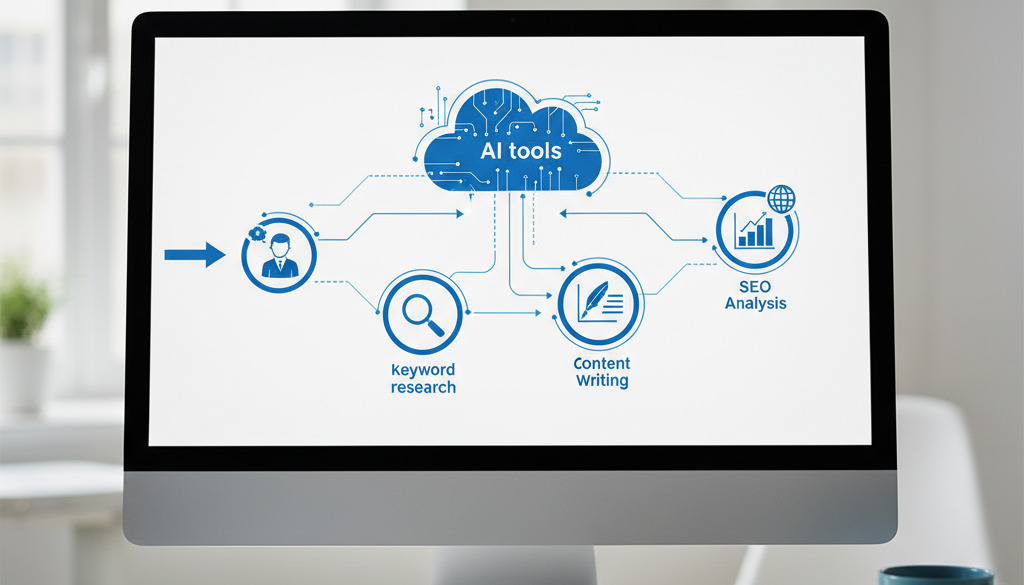
- AI is Reshaping SEO: Artificial Intelligence is no longer a futuristic concept; it's actively changing how search engines like Google rank content. The focus is shifting from simple keywords to understanding user intent and providing direct answers.
- A Level Playing Field: AI tools give small businesses a competitive edge by automating complex tasks like keyword research, content creation, and technical analysis, which were once the domain of large corporations with big budgets.
- Content is King, AI is the Kingmaker: AI can help you create high-quality, relevant, and structured content at scale. The goal is to produce information that AI-driven search engines can easily interpret and feature in summaries like AI Overviews.
- Hyper-Focus on Local SEO: For brick-and-mortar businesses, AI offers powerful ways to dominate local search, optimizing Google Business Profiles and targeting geographically specific customer queries with unprecedented accuracy.
- Actionable Data Over Vanity Metrics: AI-powered analytics move beyond simple traffic numbers, providing deep insights into user behavior, content performance, and ROI, allowing for smarter, data-driven decisions.
- Getting Started is Easier Than You Think: Many AI solutions are designed for non-technical users. Platforms exist that can generate professional, SEO-optimized articles for you, with some offering free trials to prove their value.
Introduction: The Evolving Landscape of Small Business Online Visibility
In today's digital marketplace, an online presence isn't just an asset for a small business; it's the very foundation of its survival and growth. Your customers are online, searching for answers, products, and services. If they can't find you, for all intents and purposes, you don't exist. However, as a business owner, you're likely all too familiar with the immense challenges of digital marketing. The constant demand for new content, the technical complexities of Search Engine Optimization (SEO), and the sheer lack of time and budget can feel overwhelming.[1]
But what if you could harness a force that works tirelessly, analyzes data in seconds, and provides strategic insights that could level the playing field? That force is here, and it's Artificial Intelligence (AI). AI is no longer the stuff of science fiction; it is a practical, accessible, and transformative tool that is revolutionizing SEO. It's making advanced digital marketing strategies available to small businesses that previously could only dream of competing with their larger, better-funded counterparts. This guide will show you exactly how to leverage AI to unlock unprecedented online growth.
Understanding SEO in the Age of Artificial Intelligence
Before we dive into the "how," let's clarify the "what." SEO is the practice of optimizing your website to rank higher in search engine results for relevant queries. For years, its core principles have revolved around a few key pillars. AI doesn't replace these pillars; it supercharges them.
The Core Pillars of SEO
- Keywords: The words and phrases people type into search engines.
- Content: The articles, videos, and pages on your site that provide answers and value to searchers.
- Backlinks: Links from other reputable websites to yours, acting as a vote of confidence.
- Technical SEO: The behind-the-scenes elements that help search engines crawl and index your site effectively, like site speed and mobile-friendliness.
How AI is Already Powering Search
You may not realize it, but AI has been influencing search results for years. Google uses sophisticated AI systems like RankBrain and BERT (Bidirectional Encoder Representations from Transformers) to better understand the context and nuance of human language. This means Google doesn't just match keywords anymore; it understands intent. More recently, with the introduction of AI Overviews (formerly Search Generative Experience or SGE), Google is using AI to synthesize information and provide direct answers at the top of the results page. Your new goal isn't just to rank—it's to be the authoritative source for these AI-generated answers. It's crucial to understand that AI is not a magic bullet. It's a powerful tool that amplifies human strategy and expertise. It automates the tedious and analyzes the complex, freeing you to focus on what you do best: running your business.
Why Small Businesses Need an AI-Powered SEO Strategy
For a small business owner, the most valuable resources are time and money. An AI-powered SEO strategy optimizes both. While traditional SEO is often a manual, time-intensive process, AI introduces a level of efficiency and precision that was previously unattainable. This allows smaller companies to not only compete but to excel.
By 2026, Gartner predicts that traditional search engine volume will drop by 25% as users shift toward AI-powered answers. This isn't a future trend; it's a present reality. Businesses that adapt will thrive, while those that don't will become invisible.
The Tangible Benefits of AI SEO
The shift to AI SEO delivers a competitive advantage through increased traffic, better leads, and higher customer acquisition. It's about achieving more with less. By automating tasks and providing deeper insights, AI dramatically improves your marketing return on investment (ROI). Instead of hiring a large marketing team or expensive agency for every task, you can use targeted AI tools to handle much of the heavy lifting, making your marketing budget stretch further and work harder.
Traditional SEO vs. AI-Powered SEO
Let's compare the old way with the new way:
| Aspect | Traditional SEO | AI-Powered SEO |
|---|---|---|
| Keyword Research | Manual, based on volume and competition. | Automated, focuses on user intent, semantic relevance, and predictive trends. |
| Content Creation | Slow, manual, often requires dedicated writers. | AI-assisted brainstorming, outlining, and drafting, enabling rapid content scaling. |
| Technical Audit | Manual site crawls, requires technical expertise to interpret. | Automated audits that pinpoint issues and often suggest specific fixes in plain language. |
| Performance Analysis | Based on basic metrics like traffic and rankings. | Deep analysis of user behavior, content engagement, and conversion pathways. |
Identifying Your Target Audience with AI Insights
You might think you know your customers, but AI can reveal layers of insights you've never seen. It goes beyond basic demographics like age and location. AI tools can analyze online conversations, social media trends, and competitor data to build a rich, nuanced profile of your ideal customer.
Creating Detailed Customer Personas
AI helps you understand your audience's pain points, motivations, and buying behaviors on a granular level. It can identify the specific questions they're asking online, the language they use, and the content they find most engaging. This deep understanding is the foundation of any successful SEO strategy. When you know exactly who you're talking to, you can tailor your keywords, content, and messaging to resonate perfectly, dramatically increasing your chances of conversion.
Strategic Keyword Research Enhanced by AI
Keyword research is no longer about finding a handful of high-volume terms and stuffing them into your pages. In the age of AI, it’s about understanding the entire ecosystem of search queries related to your business. AI excels at this.
Uncovering Long-Tail Keywords and User Intent
AI tools can sift through millions of searches to uncover long-tail keywords—longer, more specific phrases that indicate a user is closer to making a purchase. For example, instead of just targeting "plumber," AI might identify "emergency plumber for leaking pipe in Brooklyn." These queries have lower search volume but much higher conversion intent. AI helps you map these keywords to the three main types of user intent:
- Informational: The user wants to learn something (e.g., "how to fix a leaky faucet").
- Navigational: The user wants to find a specific website (e.g., "Google").
- Transactional: The user wants to buy something (e.g., "buy faucet repair kit").
By matching your content to the correct intent, you provide more value to the user and send positive signals to search engines.
Predicting Keyword Trends
One of the most powerful capabilities of AI is its ability to analyze data to predict emerging trends. For a small business, this is a game-changer. AI can alert you to burgeoning topics and keywords in your industry before they become hyper-competitive, allowing you to create content and capture traffic ahead of the curve.
Crafting High-Quality, AI-Assisted Content
Content creation is often the biggest bottleneck for small businesses. It requires time, expertise, and consistency. This is where AI-assisted content tools have become revolutionary. They can help you brainstorm topics, generate detailed outlines, write initial drafts, and optimize text for SEO and readability.
For many business owners over 40 who are experts in their trade but not native to the online world, the thought of writing weekly blog posts is daunting. You know it’s important, but you have neither the time nor the inclination for it. This is precisely the problem that AI-powered content services solve. For example, our "More Customers From Your Blog" service leverages a proprietary artificial intelligence that writes professional SEO blog posts for your website in minutes—it feels almost like magic.[2] It’s designed for busy entrepreneurs who need results without the learning curve.
Optimizing Existing Content with AI Tools
Your existing website is a goldmine of SEO opportunities. AI tools can perform a comprehensive content audit, analyzing every page to identify gaps and areas for improvement. These tools don't just look for keywords; they assess topic relevance, readability, and structure.

Actionable Steps for Content Refinement
An AI content analysis might reveal that your most popular service page is missing crucial information that users are searching for, or that a blog post from two years ago could be updated with new data to become relevant again. AI tools can provide concrete suggestions:
- Identify "keyword gaps": Find valuable keywords your page isn't currently targeting.
- Improve readability: Suggest simplifying complex sentences or breaking up long paragraphs.
- Enhance topical authority: Recommend adding new sections or answering related questions to make your content more comprehensive.
This process of refining and updating existing content is one of the quickest ways to see a boost in your search rankings.
Unlocking Technical SEO with AI Simplicity
Technical SEO can be the most intimidating part of search engine optimization for non-technical business owners. Terms like schema markup, site speed, and canonical tags can sound like a foreign language. However, a technically sound website is critical for ranking well.
Demystifying Technical Issues
AI is simplifying technical SEO. Modern AI-powered tools can crawl your website just like a search engine and deliver a prioritized list of issues in plain English. Instead of a cryptic error code, an AI tool might tell you, "This page loads too slowly on mobile devices, which hurts user experience," and then point you to the specific elements (like large images) causing the problem. By automating the diagnosis process, AI empowers you to fix issues that could be severely hampering your search performance without needing a computer science degree.
Building Authority: AI's Impact on Link Building
Backlinks—links from other sites to yours—remain a powerful signal of authority and trust to search engines. However, effective link building is not about getting as many links as possible; it's about getting high-quality, relevant links. AI can streamline this process significantly.
Smart Prospecting and Analysis
AI tools can analyze the web to identify authoritative websites, blogs, and directories in your niche that would be ideal link prospects. More importantly, AI can analyze your competitors' backlink profiles. This allows you to see exactly which websites are linking to them, giving you a ready-made list of prospects to target. It turns a needle-in-a-haystack search into a strategic, data-driven campaign.
Local SEO Domination with AI-Driven Strategies
For small businesses that serve a specific geographic area—like restaurants, plumbers, dentists, and retail shops—local SEO is everything. This is where your customers are, and AI is becoming indispensable for capturing their attention.
Optimizing for the "Near Me" Search
AI plays a huge role in optimizing your Google Business Profile (GBP), the single most important factor in local search ranking. AI tools can help you:
- Analyze customer reviews to identify common themes and suggest how to respond.
- Suggest Q&A content based on what local customers are asking.
- Optimize your service descriptions with keywords that are trending in your local area.
Recent studies show that search is moving away from a list of "blue links" and toward direct recommendations, especially in local search. AI engines want to provide the single best answer to a query like "best pizza in Chicago." AI helps ensure your business information is structured, consistent, and authoritative enough to be that top recommendation.
Measuring and Analyzing SEO Performance with AI
You can't improve what you don't measure. SEO is an ongoing process, and tracking your performance is critical to understanding what's working and what isn't. Traditional analytics can be overwhelming, presenting a sea of data with little context.
Insights, Not Just Data
AI-powered analytics platforms transform this data into actionable insights. They can identify which pieces of content are driving the most conversions, how users are navigating through your site before they contact you, and which keywords are delivering the most valuable traffic. Instead of just showing you a traffic spike, AI can correlate that spike with a specific blog post you published or a backlink you acquired, giving you a clear picture of cause and effect. This allows you to double down on successful strategies and eliminate those that aren't delivering ROI.

The Future of AI in Small Business SEO: Staying Ahead of the Curve
The world of search is dynamic, and AI is accelerating the pace of change. New trends like voice search ("Hey Google, find a coffee shop near me") and conversational AI (getting answers from chatbots like ChatGPT) are already impacting user behavior. The key to long-term success is to remain curious and adaptable. You don't need to be an expert on every new technology, but you should foster a mindset of proactive learning. By understanding the direction search is heading, you can position your business to take advantage of new opportunities as they arise, ensuring you stay ahead of your competition.
Implementing Your AI SEO Strategy: A Step-by-Step Approach
Feeling motivated but not sure where to start? Here’s a practical roadmap to get you going.
- Start with a Foundation Audit: Use an AI-powered SEO tool to run a comprehensive audit of your website. This will give you a baseline and a prioritized list of technical issues and content gaps to address.
- Deep Dive into Your Audience and Keywords: Employ AI tools to develop detailed customer personas and perform in-depth keyword research. Focus on user intent and long-tail opportunities.
- Optimize Your Local Presence: If you're a local business, make your Google Business Profile your top priority. Use AI insights to fully optimize every section of your profile.
- Create a Content Plan: Based on your keyword and audience research, create a content calendar. Decide which new pages to create and which existing pages to update.
- Leverage AI for Content Creation: This is where you can save the most time. For business owners who know this is critical but can't find the hours, a hands-off approach is best. It's why our service is so popular—more than 500 companies are already using it to get professional content without the hassle. And to make it a completely no-risk decision for you, your first 5 posts are free.
- Measure, Analyze, and Refine: Set up AI-powered analytics to track your progress. Pay attention to what's working and continually refine your strategy based on real-world data.
Overcoming Common AI SEO Challenges for Small Businesses
Adopting new technology always comes with a few hurdles. Let's address the most common concerns for small business owners head-on.
The Cost of AI Tools
While some enterprise-level AI platforms are expensive, the market is filled with affordable and even free tools designed specifically for small businesses. Furthermore, the cost should be viewed as an investment. The time saved and the results gained from an effective AI SEO strategy often provide a return that far exceeds the cost of the tools.
The Learning Curve
Many modern AI tools are built with a user-friendly interface, designed for marketers and business owners, not data scientists. And for the ultimate easy button, services exist that do the work for you. The goal is to find the right balance—the tools and services that fit your budget, your technical comfort level, and your available time.
Data Privacy and Trust
It's wise to be cautious about the data you share. Stick with reputable, well-reviewed AI tool providers that are transparent about their data policies. Remember that most SEO AI tools are analyzing public data from the web, not sensitive customer information from your private databases.
Conclusion: Embracing AI for Sustainable Small Business Growth
Artificial Intelligence is the great equalizer in the world of digital marketing. It takes the complex, time-consuming, and expensive elements of effective SEO and makes them accessible to everyone. By embracing AI, you are not replacing your business acumen; you are augmenting it. You are empowering your business to reach more customers, generate more leads, and build a sustainable engine for growth.
The journey starts with a single step. Don't let the technology intimidate you. Start small, focus on the foundational elements, and leverage the tools and services that can do the heavy lifting for you. The future of your business's online visibility depends on it.
Leveraging AI for Advanced Keyword Research and Content Strategy
While AI excels at automating repetitive SEO tasks and identifying basic keyword opportunities, its true power for small businesses lies in its ability to conduct more sophisticated keyword research and inform a robust content strategy. Moving beyond simple volume and difficulty metrics, AI can help uncover long-tail keywords with high purchase intent, analyze competitor keyword gaps, and predict emerging search trends. This deeper understanding allows small businesses to carve out niche markets and cater to highly specific customer needs, a crucial advantage when competing against larger, more established players.
Consider the process of identifying long-tail keywords. These are longer, more specific phrases that users type into search engines when they are closer to making a purchase decision. For example, instead of just targeting "running shoes," a small business might identify "best lightweight trail running shoes for women with flat feet" as a highly valuable long-tail keyword. AI tools can sift through vast datasets of search queries, forum discussions, and customer reviews to pinpoint these nuanced phrases. They can identify patterns in user language, understand the context of search queries, and even predict related questions that potential customers might ask. This goes far beyond traditional keyword research tools that often rely on broad match or phrase match modifiers. By understanding the conversational nature of modern search, small businesses can create content that directly answers these specific queries, attracting highly qualified leads who are more likely to convert.
Furthermore, AI can revolutionize content strategy by identifying content gaps and opportunities that might be missed by human analysis alone. AI tools can quickly audit your existing content and compare it against your competitors' top-performing content. This analysis can reveal topics that your competitors are ranking for but you are not, or areas where your content could be expanded to provide more comprehensive coverage. By understanding what resonates with your target audience on a deeper level, AI can suggest new blog post ideas, video topics, or even entire content pillars. It can analyze the sentiment and tone of successful content, helping you to adopt a voice and style that appeals to your ideal customer. This data-driven approach to content ideation ensures that your efforts are focused on creating valuable, engaging, and search-optimized material that drives meaningful results for your small business.
Uncovering Niche Keyword Opportunities with AI
Small businesses often struggle to compete with larger enterprises in broad, highly competitive keywords. Artificial intelligence offers a powerful solution by enabling the discovery of niche, long-tail keywords that are often overlooked. These keywords, while having lower search volume individually, collectively represent a significant opportunity for highly targeted traffic and improved conversion rates. AI algorithms can analyze search engine results pages (SERPs) for specific queries, identifying patterns in user behavior and the semantic relationships between keywords. This allows them to uncover variations and related phrases that a human might miss, especially those with specific intent.
For instance, an AI tool might analyze searches related to "artisanal coffee beans." Beyond identifying popular terms, it could uncover queries like "ethically sourced single-origin Ethiopian Yirgacheffe beans" or "best pour-over coffee beans for chocolate notes." These long-tail keywords are indicative of users who have a clear understanding of their preferences and are further down the purchase funnel. By targeting these specific phrases, a small coffee roaster can attract customers who are not only looking for coffee but are looking for *their specific kind* of coffee. This reduces ad spend wasted on irrelevant clicks and significantly increases the likelihood of a sale. The AI can also identify seasonal or regional variations in search queries, allowing businesses to tailor their offerings and marketing messages to capitalize on fleeting trends or local demands.
The process involves feeding identified broad keywords into AI-powered tools designed for keyword gap analysis and predictive keyword research. These tools then leverage natural language processing (NLP) to understand the intent behind user searches. They can identify semantic connections, synonyms, and related concepts that might not be immediately obvious. By analyzing competitor websites and their ranking keywords, AI can pinpoint "keyword gaps" – terms that competitors are successfully ranking for but you are not. This provides a clear roadmap for content creation, enabling small businesses to fill these gaps with high-quality, optimized content that captures previously untapped traffic. The AI's ability to process and interpret vast amounts of data quickly makes this a far more efficient and effective approach than manual research, especially for businesses with limited resources.
AI-Driven Content Strategy: From Ideation to Optimization
Once niche keyword opportunities are identified, AI can play an instrumental role in developing a comprehensive content strategy that capitalizes on these insights. This goes beyond simply writing articles; it involves strategically planning content formats, topics, and distribution channels to maximize engagement and search visibility. AI can analyze the success metrics of existing content, both your own and your competitors', to identify patterns in what captivates audiences and drives conversions. This data-driven approach ensures that content creation efforts are not shot in the dark but are guided by predictable outcomes.
AI tools can assist in generating content ideas by analyzing trending topics within your industry, identifying frequently asked questions (FAQs) from customer support logs or online forums, and even suggesting different content formats (e.g., blog posts, infographics, videos, podcasts) based on what has historically performed well for similar queries. For example, if AI identifies a cluster of searches around "how to care for succulents in low light," it might suggest a blog post titled "The Ultimate Guide to Low-Light Succulent Care," potentially recommending the inclusion of visuals and a downloadable care checklist. It can also predict the relative search volume and competition for these nascent topics, helping small businesses prioritize their content calendar effectively.
Beyond ideation, AI contributes significantly to content optimization. Tools can analyze draft content for keyword density, readability scores, and the inclusion of relevant entities and semantic terms. They can suggest improvements to headings, subheadings, meta descriptions, and internal linking structures to enhance both user experience and search engine crawlability. Furthermore, AI can help identify opportunities for content repurposing. For instance, a well-performing blog post could be transformed into a series of social media updates, an infographic, or even a short explainer video, extending its reach and maximizing its value. By continuously analyzing content performance and identifying areas for improvement, AI empowers small businesses to maintain a dynamic and effective content strategy that adapts to ever-changing search algorithms and user preferences, fostering sustainable growth and a strong online presence.
AI-Driven Content Personalization and User Journey Mapping
Beyond the initial ideation and optimization phases, a sophisticated AI-powered SEO strategy for small businesses extends into the realm of personalized content delivery. This involves leveraging AI to understand individual user behaviors and preferences, tailoring content experiences to resonate more deeply with each visitor. Instead of a one-size-fits-all approach, AI can analyze user data, including past website interactions, search history, and demographic information, to predict what content a specific user is most likely to engage with. This could manifest in dynamically changing website banners, personalized product recommendations, or even suggesting relevant blog posts or resources based on their current browsing session. For a small business, this level of personalization can significantly boost conversion rates and customer loyalty, as users feel understood and catered to. It moves beyond simply ranking for keywords to creating meaningful interactions that foster a stronger connection with the brand. This is particularly powerful for small businesses competing against larger entities with more established brand recognition; by offering a more tailored and attentive experience, they can carve out a distinct advantage.
Furthermore, AI plays a crucial role in mapping and optimizing the entire user journey. Search engine optimization is no longer solely about attracting initial traffic; it's about guiding users seamlessly through the various stages from awareness to consideration and ultimately to conversion. AI tools can analyze user flow data to identify friction points in the customer journey. For instance, if many users drop off at a particular stage of the checkout process or abandon a certain product page, AI can highlight these areas. It can then propose solutions, such as simplifying forms, adding more compelling calls-to-action, or providing richer product information where needed. By understanding the path a user takes, small businesses can proactively address potential issues and ensure a smoother, more efficient experience. This holistic approach to SEO, encompassing both content creation and the user's journey through the site, is a hallmark of effective AI-driven strategies, ensuring that every touchpoint is optimized for maximum impact and conversion.
Enhancing User Experience Through Predictive Content Delivery
Predictive analytics, a key component of AI in SEO, allows small businesses to anticipate user needs before they are even explicitly stated. By analyzing patterns in website traffic and user behavior, AI can predict what information or products a user might be searching for next. This foresight enables proactive content delivery, serving up relevant information or offers at the opportune moment. Imagine a user browsing travel destinations; AI could, based on their viewed locations and search queries, predict their interest in specific activities or accommodation types and instantly present relevant blog posts about "best local restaurants" or "family-friendly hotels" in that region. This not only enhances the immediate user experience by providing timely and valuable content but also reduces bounce rates and encourages deeper engagement with the website. For small businesses, this predictive capability transforms their website from a static brochure into an intelligent, responsive platform that actively assists users, fostering a sense of trust and reliability.
FAQ
What is AI-powered SEO for small businesses?
AI-powered SEO utilizes artificial intelligence to automate and optimize various aspects of search engine optimization. For small businesses, this means leveraging AI tools to improve keyword research, content creation, technical SEO, and performance analysis more efficiently.
How can AI SEO benefit a small business?
AI SEO can significantly benefit small businesses by saving time and resources, identifying new content opportunities, personalizing user experiences, predicting trends, and ultimately improving search engine rankings and driving more targeted traffic to their website.
Are AI SEO tools expensive for small businesses?
While some advanced enterprise-level AI SEO platforms can be costly, many AI-powered tools offer tiered pricing or freemium models that are accessible to small businesses. The return on investment in terms of improved SEO performance often outweighs the cost.
Keep reading
Hand-picked guides that go deeper — open the one you need next:
- Google Business Profile AI Content: The 2026 Strategy Guide
- Boost Your Local Business with AI-Powered SEO Content
- The Future of Content Marketing: Why AI is Essential for Small Businesses
- The Entrepreneur's Secret Weapon: AI Content Marketing
→ Read the full Small Business guide