
Write Less, Rank More: AI Blog Writing for SEO Success

As a business owner, you know that a steady stream of high-quality blog content is essential for attracting customers and growing your online presence. You also know that finding the time and resources to create that content feels like a monumental task. It’s the classic content conundrum: you need it to succeed, but you don’t have the bandwidth to produce it. What if you could solve this problem, unlocking consistent, expert-level content without sacrificing countless hours or hiring an expensive team? The solution is already here, and it’s transforming how businesses approach digital marketing.
Key Takeaways
- AI is Now Mainstream: AI writing tools are no longer futuristic novelties; they are essential infrastructure for modern content marketing, with studies showing over 82% of businesses already use them for content production.
- Solves the Time-Scarcity Problem: For busy SME owners, AI drastically reduces the time needed to draft blog posts, moving from hours or days to mere minutes for a first draft.
- SEO and AI Are a Powerful Combination: Modern AI tools are designed to integrate SEO principles, helping with keyword research, content structure, and readability to improve Google rankings.
- Human Oversight is Non-Negotiable: AI is a powerful assistant, not a replacement for human expertise. The best results come from an AI-generated draft that is then refined, fact-checked, and personalized by a human editor.
- Specialized Tools Offer Better Results: While general chatbots are useful, specialized AI writing platforms designed for SEO blogging provide superior structure, optimization, and brand alignment for business content.
Understanding the Evolving Landscape of Content Creation
The days of relying solely on traditional advertising are over. Today, a powerful online presence is built on a foundation of value. This is the core of content-driven inbound marketing—a strategy where you attract customers by providing them with useful, relevant information. Your blog is the engine of this strategy. Each article is an opportunity to answer a potential customer’s question, solve their problem, and build trust in your brand.
For small to medium-sized enterprises (SMEs), especially those run by seasoned professionals who are not digital natives, maintaining this engine can be a daunting challenge. The primary hurdles are often a lack of time, a lack of writing expertise, or uncertainty about what to even write about. This is where the landscape is evolving. The demand for consistent, high-quality content hasn’t changed, but the tools we use to create it have been revolutionized.
What is AI-Powered Blog Writing?
At its core, an AI writing tool is a type of software that uses artificial intelligence to generate human-like text. It’s not magic; it’s advanced technology. These platforms are built on large language models (LLMs) that have been trained on billions of data points, including books, articles, and websites. This extensive training allows them to understand grammar, context, style, and nuance with remarkable sophistication.
It's important to differentiate between a basic text generator (like a simple chatbot) and a sophisticated AI writing platform built specifically for professional content. While a general tool can string sentences together, a specialized AI for blog writing understands the components of a successful article: an engaging introduction, structured arguments with proper headings, natural keyword integration, and a compelling conclusion. They are purpose-built to create content that not only reads well but also performs well on search engines.
The "Why": Demonstrating the Business Value of AI Blog Content
Adopting AI for your blog isn't about chasing a trend; it's about achieving tangible business results. The benefits are clear, direct, and impact your bottom line.
- Increased Website Traffic: Every new, optimized blog post is another page for Google to index and another opportunity for a customer to find you. AI allows you to scale this production, creating more entry points to your website.
- Improved Search Engine Rankings (SEO): AI tools are adept at weaving in relevant keywords and structuring content in a way that search engine algorithms favor. This consistency helps build your site's authority, pushing you up in search results for topics your customers care about.
- Enhanced Brand Authority: Regularly publishing insightful content positions you as an expert in your field. When customers see you consistently providing answers and value, they are more likely to trust you when it comes time to make a purchase.
"AI doesn't just make content creation easier; it democratizes it. Suddenly, any business can have a powerful, consistent voice in the marketplace, competing on the quality of their ideas, not the size of their marketing department."
Busting AI Blog Writing Myths: Addressing Common Concerns
For many business owners, the idea of using AI to write feels foreign and raises valid questions. Let’s address some of the most common myths.
Myth 1: The Content Will Be Robotic and Lack Personality.
This was a legitimate concern with older generations of AI, but modern models like Claude Opus and GPT-5 are far more sophisticated. More importantly, you are always in control. You guide the AI with prompts about tone, style, and perspective. The AI provides a high-quality draft, and you provide the final layer of personality and unique insight. It’s a partnership.
Myth 2: AI Will Completely Replace Human Writers.
This is highly unlikely. AI is a tool—a remarkably powerful one—but it lacks genuine experience, creativity, and strategic understanding. The winning formula is *AI-assisted human expertise*. AI handles the heavy lifting of drafting, while humans focus on higher-value tasks: strategy, editing, and ensuring the content aligns perfectly with the brand’s message.
Myth 3: AI-Generated Content is Unoriginal and Plagiarized.
Reputable AI writing tools do not copy and paste from their training data. They generate statistically probable, new combinations of words based on the patterns they have learned. While the risk of accidental similarity always exists (even with human writers), high-quality tools have built-in checks and are designed to produce original content.
Identifying the Right AI Tool for Your Business Needs
The market is flooded with AI writers, but not all are created equal. As a business owner, you need a tool that simplifies your life, not one that requires a degree in prompt engineering. Look for these key features:
- Ease of Use: The interface should be intuitive for someone who isn't a tech expert.
- SEO Integration: The best tools don’t just write; they help you optimize for search engines.
- Customization Options: You need to be able to guide the tool to match your brand's unique voice and tone.
- Output Quality: The resulting text should be well-structured, coherent, and require minimal editing.
While general-purpose tools like Gemini or ChatGPT are flexible, many businesses find greater success with specialized platforms. For instance, services promising "More Customers From Your Blog" are built from the ground up to address the very specific need of SME owners. Instead of a blank canvas, they provide a focused experience designed to produce professional SEO articles with a business goal in mind, using proprietary AI to ensure the output aligns with commercial objectives.
The Core Functionality: How AI Generates Blog Posts
For the user, the process is surprisingly straightforward. While the underlying technology is complex, a good AI writing platform handles the complexity for you. A typical workflow looks like this:
- Provide Your Input: You start by giving the AI a topic or a title. For better results, you might also include target keywords, a desired tone of voice (e.g., "professional," "friendly," "expert"), and a brief description of the target audience.
- AI Analysis and Generation: The AI analyzes your input. It scours its knowledge base to understand the topic, identify key concepts, and structure a logical narrative. Within minutes, it generates a full-length article, complete with an introduction, H2 and H3 headings, and a conclusion.
- Review and Refine: You receive a complete draft. This is where the human element comes in, a step we will explore further. The AI has saved you the 90% of the effort involved in starting with a blank page.
Optimizing for Search Engines (SEO) with AI
One of the most significant advantages of using a modern AI writer is its built-in SEO capabilities. In the past, writing and SEO were two separate, often conflicting, tasks. AI merges them into a single, streamlined process.
Keyword Integration
AI can analyze a primary keyword and identify semantically related terms and phrases that Google expects to see in a comprehensive article. It then naturally places these keywords throughout the text, including headings and body paragraphs, avoiding the "keyword stuffing" that search engines penalize.
Content Structure
Search engines favor well-structured content because it's easier for both their crawlers and human readers to understand. AI excels at this, automatically organizing articles with a logical hierarchy of headings (H2s and H3s), using lists, and keeping paragraphs short and readable.
Readability and Length
AI tools can be instructed to write at a specific reading level (typically 8th or 9th grade for general blog content) to ensure it is accessible to a broad audience. They can also generate content that meets the optimal length for a given topic, a key factor in ranking for competitive keywords.

Preserving Your Brand Voice and Authenticity
Your brand’s voice is its personality. It’s what makes you recognizable and builds connection with your audience. A common fear is that AI will dilute this voice. However, with the right approach, AI can actually help you strengthen it.
The key is to treat the AI as an apprentice that needs to be trained. You can do this by providing it with clear style guidelines. For example, your prompts can specify: "Write in an encouraging and expert tone. Avoid corporate jargon. Use the second person ('you') to address the reader directly." Some advanced platforms can even analyze your existing website content to learn your style automatically.
Ultimately, authenticity comes from your unique insights. Use the AI-generated draft as the foundation, then weave in your own experiences, stories, and expert opinions. This combination of AI efficiency and human authenticity creates content that is both scalable and resonant.
The Human Element: Editing and Refining AI-Generated Content
To be clear: you should never copy, paste, and publish an AI-generated article without human review. The magic of AI content lies in the collaboration between machine and human. An AI draft is a starting point, not a finished product. Here is your essential editing checklist:
- Fact-Check All Claims: While AI has become more accurate, it can still make mistakes or "hallucinate" facts. Verify all data, statistics, and specific claims.
- Add Personal Anecdotes and Examples: Where did you see this principle in action with a client? What’s a personal story that illustrates the point? These additions are uniquely human and build powerful connections.
- Ensure Seamless Flow and Tone: Read the article aloud. Does it flow naturally? Are there any awkward phrases or shifts in tone? Smooth these out to match your brand voice perfectly.
- Inject Your Unique Perspective: What is your opinion on the matter? Do you have a contrarian view? Your unique perspective is what elevates the content from being merely informative to being truly valuable.
Practical AI Content Creation Workflows for SMEs
For a small or medium-sized business, AI can be integrated into your workflow in several practical ways.
Generating Topic Ideas
Stuck on what to write about? Feed an AI your general industry and target audience, and ask it to brainstorm a list of blog post titles that address common customer pain points. For example: "Generate 20 blog titles for a financial advisor targeting people near retirement."
Drafting Initial Sections
The "blank page" problem is one of the biggest killers of productivity. Use AI to draft your introduction, outline, or a specific section you're struggling with. This momentum makes the rest of the writing process dramatically easier.
Enhancing Existing Content
Your old blog posts are a goldmine. Use AI to refresh and expand them. Provide the text of an old post and ask the AI to "add a new section on the latest 2026 trends" or "rewrite this to be more comprehensive and increase the word count to 2,500 words."
Streamlining Your Content Calendar with AI Efficiency
Consistency is king in content marketing. Search engines and readers alike reward a regular publishing schedule. For a time-strapped business owner, this is often the hardest part. One high-quality article per month is quickly forgotten. But what if you could publish one per week?
This is where AI’s efficiency shines. By collapsing the drafting process from hours to minutes, you can realistically plan and execute a robust content calendar. You can batch-create four drafts in a single morning, then spend the rest of the week refining them. This cadence signals to Google that your site is active and relevant, and it keeps your audience engaged and coming back for more.
This is the core promise of platforms dedicated to helping you get more customers from your blog. They understand that for a business, the goal isn't just writing—it's publishing consistently. They are designed around the principle that "We write the SEO articles for you," enabling you to maintain that crucial cadence without taking you away from running your business.
Measuring the Success of Your AI-Powered Blog Strategy
Creating the content is only half the battle. You need to know if it’s working. Track these key performance indicators (KPIs) using free tools like Google Analytics and Google Search Console:
- Organic Traffic: Are more people finding your website through search engines?
- Keyword Rankings: Are you starting to appear on the first page of Google for your target keywords?
- Time on Page: Are people actually reading your articles? A higher time on page suggests the content is engaging.
- Conversion Rate: Are readers taking the next step, such as signing up for your newsletter, contacting you, or making a purchase?
By monitoring this data, you can see which AI-assisted articles are performing best. Double down on what works and refine your approach for future content.
The Future of AI in Content Marketing: What to Expect
The field of AI is moving at lightning speed. We can expect future tools to become even more integrated and intuitive. Soon, AI might not just write the content but also suggest the best channels to promote it on, predict its performance, and even personalize it in real-time for different website visitors. Models will gain a more nuanced understanding of user intent, allowing them to create content that answers not just the question asked, but the underlying need.
However, one thing will remain constant: the strategic importance of human-centric content. The goal will always be to create value for your reader. AI will simply become an even more powerful enabler for achieving that goal at scale.
Implementing AI Blog Writing: A Step-by-Step Guide for Businesses
Ready to get started? Here’s a simple four-step plan to integrate AI into your content strategy.
Assess Your Needs
What are your primary goals? More website traffic? More leads? A stronger brand presence? What are your biggest content bottlenecks right now? Knowing your goals will help you choose the right tool and measure success.
Research and Select Your Tool
Based on your needs, evaluate your options. Do you need a flexible, general-purpose tool, or would a specialized platform be more efficient? For those who want a turnkey solution without a steep learning curve, a service built to deliver professional SEO articles might be the answer. As one such service promises, "Our proprietary artificial intelligence writes professional SEO blog articles for your website in minutes—almost like magic." Look for offers to test the platform; for example, some provide a risk-free trial where Your first 5 posts are free.
Integrate and Test
Don’t try to overhaul your entire content strategy overnight. Start with one or two blog posts. Use the tool, learn its nuances, and develop a workflow for your editing process. This initial test phase is crucial for building a sustainable system.
Establish an Editing Protocol
Create a clear, simple checklist for your human review process (refer to the one above). This ensures that every piece of content meets your quality standards for accuracy, tone, and authenticity before it goes live.
Overcoming the Learning Curve: Tips for Success
Adopting any new tool requires a period of adjustment. Don’t be discouraged if your first few attempts aren’t perfect. Success with AI writing comes from treating it as a collaborative process.
- Experiment with Prompts: The quality of your output depends heavily on the quality of your input. Try different ways of phrasing your instructions to see what yields the best results.
- Be Patient: Learn the strengths and weaknesses of your chosen tool. It might be great at structuring articles but need more help with tone, or vice versa.
- Think of it as a Partner: View the AI not as a magic button, but as a hyper-efficient junior writer. It does the initial legwork, and you provide the senior-level strategic polish.
AI vs. Traditional Content Creation: A Comparative Analysis
For business owners who value a clear cost-benefit analysis, here is how AI-assisted content creation stacks up against the traditional manual process.
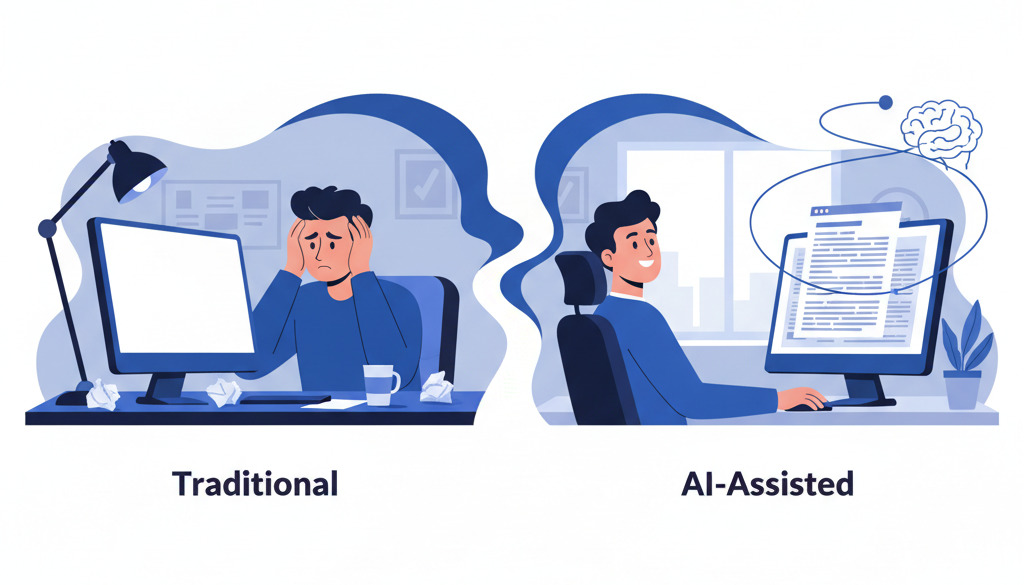
| Factor | Traditional Content Creation (Manual) | AI-Assisted Content Creation |
|---|---|---|
| Time Investment | 4-8 hours per article (research, writing, editing) | 1-2 hours per article (prompting, editing, refining) |
| Cost Implications | High (cost of hiring freelance writers, agencies, or salaried staff) | Low to Moderate (monthly subscription to an AI tool, often less than the cost of one freelance article) |
| Scalability | Low (output is directly tied to human hours available) | High (can generate multiple drafts in a fraction of the time) |
| Consistency | Difficult to maintain due to time and resource constraints | Easier to maintain, enabling a regular publishing schedule |
Ethical Considerations and Best Practices in AI Content Generation
With great power comes great responsibility. Using AI ethically is crucial for maintaining the trust of your audience and the integrity of your brand.
- Be Transparent (When Appropriate): While there’s no universal rule, consider being open about your use of AI if it feels right for your brand. However, since the final product is heavily edited and approved by you, it is ultimately your content. The industry consensus is that disclosure is not required if the content has undergone significant human review.
- Prioritize Factual Accuracy: Never blindly trust the AI. The responsibility for the accuracy of what you publish rests with you. Always fact-check.
- Avoid Plagiarism: Use reputable tools with built-in originality checkers and always review the content to ensure it is unique.
- Add Human Value: The most ethical and effective way to use AI is to ensure it is a starting point, not the end product. Your human insight is what makes the content truly valuable and defensibly your own.
Conclusion: Empowering Your Business with Smart Content Strategies
The challenge of creating consistent, high-quality blog content is real, but it is no longer insurmountable. AI writing technology offers a powerful solution for busy business owners, transforming a time-consuming chore into a manageable and highly effective marketing strategy. By embracing AI as a collaborative partner, you can dramatically increase your content output, improve your SEO performance, and establish yourself as an authority in your field. The relationship is synergistic: AI provides the efficiency and scale, while you provide the strategy, authenticity, and expert oversight.
This is the future of content marketing—not a world without human creativity, but one where technology handles the heavy lifting, freeing you up to focus on what matters most: sharing your expertise and growing your business. It’s time to write less, rank more, and finally achieve the goal of getting more customers from your blog.
Frequently Asked Questions
Will Google penalize my website for using AI-written content?
No. Google has been clear that its focus is on the quality of the content, not how it is produced. As long as your content is original, helpful, and provides a good user experience (which requires human editing and oversight), it will not be penalized. Google itself is a heavy investor in AI. The key is to produce content for people first, not for search engines.[1]
How much human editing is really needed for an AI-generated article?
It varies by the quality of the tool and the complexity of the topic, but you should budget for at least 30-60 minutes per article. This time should be spent on fact-checking, refining the tone to match your brand, adding personal anecdotes or examples, and ensuring the overall flow is smooth and engaging. The goal is to elevate the draft from "good" to "great."
Can an AI writing tool truly match my brand's unique voice?
It can get remarkably close with the right guidance. The key is to provide the AI with very specific instructions (prompts) regarding your desired tone, style, and vocabulary. For example, instead of just saying "write a blog post," you might say "write a blog post in a professional but friendly tone, addressing busy entrepreneurs. Avoid jargon and use short, clear sentences." The more specific your input, the closer the output will be to your brand voice, which you can then perfect during the editing phase.
Is AI blog writing expensive for a small business?
Compared to traditional methods, it is highly cost-effective. A monthly subscription to a quality AI writing tool often costs less than hiring a freelance writer for a single article. When you consider the time saved and the volume of content you can produce, the return on investment is significant. Many specialized services also offer free trials, like providing the first 5 posts for free, allowing you to test the value before committing.
What is the difference between ChatGPT and a specialized AI blog writing service?
Think of ChatGPT as a general-purpose toolkit—tremendously flexible but requiring you to build everything from scratch with detailed prompts. A specialized AI blog writing service is like a purpose-built machine. It's designed specifically for creating SEO-optimized articles, often with a more streamlined workflow, built-in SEO features, and an AI model trained to produce content that aligns with business and marketing goals right out of the box.
Keep reading
Hand-picked guides that go deeper — open the one you need next:
- SEO 2026: Best Practices
- AI Content Keyword Research: The 2026 Strategy Guide
- Best SEO Tools 2026
- Mastering SEO Optimized Blog Articles: A Strategic Blueprint
Sources
- Google's stance on AI content