
Automated Content Publishing for E-commerce
Key Takeaways
- Reduced Administrative Work: Store owners using automation see up to a 40% reduction in time spent on repetitive administrative tasks, freeing them up to focus on growth.
- Significant Conversion Lifts: Implementing AI-powered search and personalization on Shopify can lead to a 15-30% lift in conversions by improving the customer journey and product discovery.
- The New Infrastructure: E-commerce automation is no longer an add-on; it's essential infrastructure. Top-performing Shopify stores use an average of 4-6 specialized AI systems to manage everything from content to customer support.
- Content is King, Automation is the Kingmaker: Consistently publishing high-quality, SEO-optimized content is critical for organic traffic. Automation makes this scalable and sustainable for even the smallest teams.
- Human Oversight is Crucial: While automation is powerful, the most successful strategies use AI as a co-pilot, not an autopilot. Human review is essential for maintaining brand voice, authenticity, and quality.
Understanding the Core of E-commerce Content Automation
In the bustling digital marketplace, running a Shopify store is a demanding venture. You're not just a business owner; you're a marketer, a salesperson, a customer service representative, and often, a content creator. This last role has become increasingly vital, yet it's also one of the most time-consuming. If you feel like you're on a never-ending content treadmill, you're not alone. The solution isn't to work harder—it's to work smarter. This is where e-commerce content automation comes in as a transformative strategy for growth.[2]
What is Content Automation?
Content automation is much more than simply scheduling a social media post in advance. True automation involves using technology and intelligent systems to handle the entire lifecycle of your content. This includes:
- Generation: Creating written or visual content from scratch using data and AI.
- Optimization: Refining content for search engines (SEO), readability, and user engagement.
- Distribution: Publishing and promoting content across various channels like your blog, social media, and email newsletters.
- Personalization: Tailoring content to specific customer segments or individual user behavior.
Essentially, it's about building a system that can produce and manage high-quality content at scale, freeing you from the manual, repetitive tasks that consume your day.
Why Shopify Merchants Need Automation Now More Than Ever
The competitive landscape on Shopify is fiercer than ever. Recent data shows that the average merchant now manages significantly more products and operates across multiple sales channels. At the same time, customer expectations have soared. They demand fresh content, personalized experiences, and instant information.
According to industry analysis, top-performing Shopify stores have 3.4 times higher revenue growth than their non-automated counterparts. Automation isn't just a luxury for large corporations anymore; it's a critical survival tool for small and medium-sized businesses.
The primary benefits are clear: drastic time savings and significant cost reduction. Tasks that once took hours, like writing unique product descriptions for 100 new items, can now be accomplished in minutes. This reclaimed time is invaluable, allowing you to focus on strategy, customer relationships, and growing your business.
The Pillars of E-commerce Content Automation for Shopify
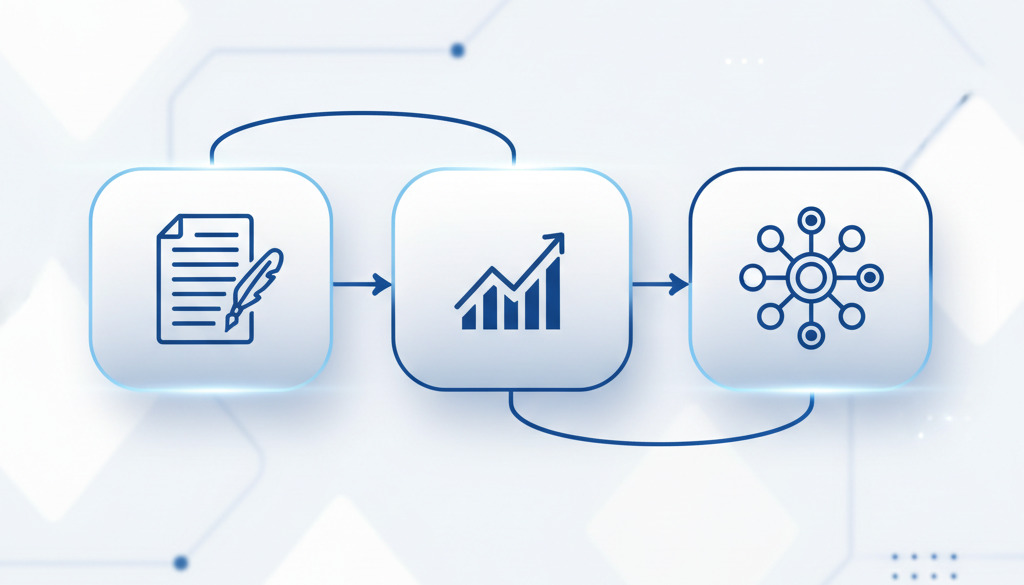
A strong content automation strategy is built on three fundamental pillars. Understanding each one helps you identify the biggest opportunities for your Shopify store.
Content Generation Automation
This is the most revolutionary aspect of content automation. It involves using AI-driven tools to create original written content. Think of it as a tireless writing assistant. This can range from crafting compelling product descriptions that highlight key features and benefits, to writing entire blog posts that attract organic traffic, to generating snappy copy for your social media updates.
Content Optimization Automation
Creating content is only half the battle. To be effective, it needs to be discoverable and engaging. Optimization automation uses tools to enhance your content without manual effort. This includes integrating target SEO keywords naturally, analyzing and improving readability scores, generating meta titles and descriptions, and even A/B testing different headlines or calls to action to see what converts best.
Content Distribution Automation
Once you have great content, you need to get it in front of the right audience. Distribution automation creates workflows that publish your content across all your channels seamlessly. A new blog post can be automatically shared on your Facebook and X (formerly Twitter) accounts, featured in your weekly email newsletter, and linked from relevant product pages, all without you lifting a finger.
AI-Powered Content Creation: The Engine of Shopify Automation
Artificial intelligence is the fuel that makes modern content automation possible. For Shopify store owners, this technology directly addresses some of the most persistent content challenges, turning laborious tasks into efficient, automated processes.
Leveraging AI for Product Descriptions
If you have a large product catalog, you know the pain of writing unique, persuasive descriptions for every single item. It's often a task that gets rushed or overlooked, leading to generic copy that fails to convert. AI tools can revolutionize this process. By feeding the AI your product's raw data—specifications, materials, target audience—it can generate dozens of unique, benefit-driven descriptions in seconds. These tools can be trained on your brand voice, ensuring every description sounds like it came directly from you.
Crafting Engaging Blog Content with AI
A blog is one of the most powerful tools for driving organic traffic and establishing your brand as an authority. However, consistently publishing high-quality posts is a massive commitment. For many business owners who lack the time or inclination to write, AI offers a powerful solution. Services that focus on getting you **"More Customers From Your Blog"** have developed proprietary AI that can produce professional, SEO-ready articles in minutes. Instead of staring at a blank page, you can provide a topic or keyword, and the AI will handle the research, outlining, and drafting, delivering content that is designed to rank on Google and attract shoppers.
Personalized Email and Social Media Copy
Automation allows you to personalize your marketing at scale. AI can analyze customer data—like past purchases and browsing history—to generate dynamic email content. Imagine sending an email with a subject line and product recommendation that is uniquely tailored to each recipient. The same technology can create varied social media posts for different platforms, optimizing the tone and format for each audience, from short, punchy updates for X to more visual, story-driven posts for Instagram.
Streamlining Content Workflow with Automation Tools
Implementing automation isn't just about adopting new tools; it's about rethinking your entire content workflow to build a more efficient and scalable operation.
Identifying Key Automation Opportunities in Your Shopify Store
Before you invest in any software, conduct a simple content audit. For one week, track the time you spend on various content-related tasks. Where are the biggest bottlenecks?
- Are you spending hours writing and rewriting product descriptions?
- Does creating a single blog post take an entire day?
- Is your social media presence inconsistent because you forget to post?
- Are you manually answering the same customer questions over and over?
Your goal is to pinpoint the most repetitive, time-consuming tasks. These are the prime candidates for your first foray into automation.
Integrating Automation Tools with Shopify
The beauty of the Shopify ecosystem is its flexibility. Most modern automation tools are built to integrate seamlessly with your store via apps, plugins, or APIs.[1] This is crucial because it allows for a smooth flow of data. For example, when an AI tool generates a product description, a good integration allows you to push that description directly to the corresponding product page in your Shopify admin with a single click. The key is to ensure the tools in your "tech stack" can talk to each other to create compounding value.
Case Study: A Shopify Store's Automation Journey
Consider the "before and after" of a hypothetical Shopify store selling handmade leather goods. Before automation, the owner spent about 15 hours per week on content: writing two blog posts a month, updating product descriptions for new arrivals, and trying to post daily on social media. After implementing a content automation strategy, the workflow transformed. An AI writing assistant now generates drafts for four blog posts a month, which the owner reviews and personalizes in under an hour. A product description generator creates unique copy for all new products instantly. A social media scheduler automatically posts content, including linking to the new blog posts. The result: The owner reclaimed over 12 hours per week, doubled their blog output, and saw a measurable increase in organic traffic and sales.

Beyond Text: Automating Visual Content for E-commerce
While written content is a huge part of e-commerce, automation is also making inroads into the world of visuals. These tools are designed to handle the repetitive, less creative aspects of managing visual assets.
AI-Assisted Image Tagging and Categorization
If your Shopify store has thousands of product images, organizing them can be a nightmare. AI can automatically "see" and understand the content of your images, generating descriptive tags (e.g., "red t-shirt," "leather ankle boots," "long-sleeve," "V-neck"). This not only aids in backend organization but also dramatically improves your site's internal search functionality and image SEO.
Generating Basic Visual Assets
Need a simple graphic for a flash sale announcement? There are AI-powered tools that can generate professional-looking social media graphics from a simple text prompt. Furthermore, automation can handle tedious tasks like resizing a single hero image into the various formats required for your homepage banner, email header, and Facebook ad, saving your team valuable time.
Video Content Automation: Emerging Trends
The next frontier is video. While still in its early stages, AI is beginning to play a role in video creation. Emerging tools can stitch together product photos and text to create simple product showcase videos or automatically edit longer footage into shorter, shareable clips. As this technology matures, it will offer yet another way for Shopify merchants to create engaging content at scale.
The SEO Advantage: How Automation Fuels Organic Growth
Search Engine Optimization (SEO) is the art and science of getting your store to appear at the top of Google search results. Content is the foundation of good SEO, and automation is the key to doing it consistently and effectively.
Consistent Keyword Integration
To rank on Google, you need to show that your site is an authority on the products you sell. This means naturally incorporating relevant keywords throughout your content. Doing this manually across hundreds of product pages, blog posts, and category descriptions is a monumental task. Automation tools, particularly AI writers, can be programmed to include your target keywords strategically, ensuring your entire site is optimized for search.
Automated Content Audits and Performance Tracking
How do you know which content is driving traffic and which is falling flat? Automation tools can connect to your Google Analytics and Shopify data to provide clear, actionable reports. They can flag underperforming blog posts that need an update, identify pages with low conversion rates, and track your keyword rankings over time—all without you having to build a single spreadsheet.
Driving Organic Traffic with AI-Generated Content
Ultimately, the goal of SEO is to have customers find you on their own through search. This is where AI-driven content generation truly proves its worth. When you can consistently publish high-quality blog posts optimized for relevant search terms, you send a powerful signal to Google that your site is a valuable resource. The core promise of specialized AI content services is that customers will find you on their own in Google search, because the content is created from the ground up for maximum search engine visibility.
Measuring the ROI of E-commerce Content Automation
As a business owner, any new investment must be justified. Fortunately, the return on investment (ROI) from content automation is both significant and measurable.
Key Performance Indicators (KPIs) to Track
To understand the impact of automation, you need to track the right metrics. Create a simple dashboard to monitor these KPIs before and after implementation:
| Metric | What it Measures | Why it Matters |
|---|---|---|
| Time Saved (Hours/Week) | Reduction in manual hours spent on content tasks. | This is your most immediate return, freeing up time for high-value activities. |
| Content Output Volume | Number of blog posts, product descriptions, etc., produced. | Measures your ability to scale content production. |
| Organic Website Traffic | Visitors arriving from search engines. | A direct indicator of your SEO success. |
| Conversion Rate | Percentage of visitors who make a purchase. | Shows the effectiveness of your content in persuading customers. |
| Customer Engagement | Likes, shares, comments, email open rates. | Measures how well your content resonates with your audience. |
Calculating Cost vs. Benefit
The calculation is straightforward. On one side, you have the monthly subscription costs for your automation tools. On the other, you have the benefits: the monetary value of the time you've saved (your hourly rate x hours saved), plus the additional revenue generated from increased traffic and higher conversion rates. For most Shopify stores, the benefits quickly and decisively outweigh the costs.
The Hidden Benefits: Increased Agility and Scalability
Beyond the hard numbers, automation gives your business two powerful advantages. Agility is the ability to react quickly to market trends. If a new product category is suddenly trending, you can use AI to generate dozens of blog posts and social updates about it in a single afternoon. Scalability is the ability to grow your content output without a proportional increase in headcount or cost, a crucial advantage for growing businesses.

Ethical Considerations and Best Practices in Content Automation
With great power comes great responsibility. While AI offers immense benefits, it's crucial to use it ethically and intelligently to protect your brand's integrity.
Maintaining Authenticity and Brand Voice
The single most important rule of using AI content is this: always maintain human oversight. AI is a phenomenal first-draft writer, but it can't perfectly capture your unique brand personality, stories, and values. Your role as the business owner is to review, edit, and infuse every piece of AI-generated content with your authentic voice. Use the AI to do 80-90% of the work, and use your human touch to add the final 10-20% that makes it truly yours.
Avoiding Duplicate and Low-Quality Content
A major risk of poorly implemented automation is producing generic or repetitive content that can hurt your SEO and alienate your audience. Quality control is paramount. Always use plagiarism checkers to ensure uniqueness and set clear guidelines for the tone, style, and quality you expect from any generated content. Reputable AI tools have built-in safeguards against producing duplicate content, but a final human check is always recommended.
Transparency with Your Audience
There is currently no requirement to disclose the use of AI in creating marketing copy or blog posts. The general consensus is that if the content is high-quality, truthful, and has been reviewed and approved by a human, it stands on its own merit. The key is to never sacrifice quality or accuracy for the sake of speed.
Choosing the Right Content Automation Tools for Your Shopify Store
The market for automation tools is vast and growing. The key is to find the right solutions for your specific needs and budget.
Types of Automation Tools Available
Tools can generally be grouped by their primary function:
- AI Writing Assistants: These tools, which range from general-purpose writers to specialized blog and description generators, form the core of content generation.
- Marketing Automation Platforms: Solutions like Klaviyo or Omnisend automate email and SMS marketing, often with built-in AI copy features.
- SEO Optimization Tools: Platforms like SurferSEO or Clearscope help you optimize your content for search engines.
- Integration Hubs: Tools like Shopify Flow or Zapier act as the glue that connects different apps and automates workflows between them.
Factors to Consider When Selecting Tools
When evaluating a tool, ask these questions:
- Shopify Compatibility: Does it have a dedicated Shopify app or a seamless integration?
- Ease of Use: Is the interface intuitive for someone who isn't a tech expert?
- Core Features: Does it solve your biggest content bottleneck effectively?
- Pricing & Scalability: Does the pricing model fit your budget, and can it grow with your business?
- Customer Support: Is help available if you get stuck?
The Power of a Low-Risk Start
You don't need to commit to expensive, complex software from day one. Many excellent tools offer free trials or freemium plans. This allows you to test the waters and see real results before you invest. For example, some AI content solutions are trusted by **over 500 companies** and are so confident in their platform that they let you **generate your first 5 articles for free**. This is a perfect, no-risk way to experience the power of automation firsthand.
Implementing a Successful Content Automation Strategy on Shopify
A thoughtful implementation plan will ensure a smooth transition and maximize your chances of success.
Starting Small and Iterating
Don't try to automate everything at once. Choose one high-impact, low-complexity task to start with. A perfect first project is automating product descriptions for a single category or generating one AI-assisted blog post per week. Master this one area, measure the results, and then expand your efforts based on what you've learned.
Training Your Team (or Yourself)
While many tools are user-friendly, there is always a learning curve. Dedicate a few hours to watching tutorials and reading guides. Understand the features and best practices for the tools you choose. The small investment in learning upfront will pay huge dividends in efficiency later.
Setting Realistic Expectations
Content automation is a powerful tool, not a magic wand. It won't build your entire business for you. Human strategy is still essential. You still need to decide which products to sell, what topics to write about, and what your brand stands for. View automation as a way to execute your vision more efficiently, not as a replacement for that vision.
The Future of E-commerce Content Automation and Shopify
The world of AI is moving at lightning speed, and the capabilities of content automation will only become more impressive over the next few years.
Advancements in AI and Natural Language Processing
We are rapidly moving toward a future of agentic commerce, where AI agents may shop on behalf of consumers. Future AI will not just write a blog post; it will suggest the topic based on real-time trends, write the content, generate accompanying images, and schedule it for optimal engagement, all from a single prompt. Personalization will become hyper-personalization, with website content dynamically changing for every individual visitor.
Integration with Emerging Technologies
Expect to see content automation become more deeply integrated with voice search, augmented reality (AR) shopping experiences, and other emerging e-commerce trends. Imagine a customer asking their smart speaker for "the best eco-friendly yoga mat," and an AI-powered content engine ensuring your product is the one it recommends.
The Evolving Role of the E-commerce Marketer
For Shopify store owners, your role will continue to shift from being a manual *content creator* to a high-level *content strategist and AI manager*. Your job will be to direct the tools, set the strategic vision, and provide the essential human touch that AI cannot replicate.
Overcoming Common Challenges with Content Automation
While the benefits are immense, it's wise to be aware of potential hurdles so you can navigate them effectively.
Initial Setup Complexity
Integrating several new tools can seem daunting. The key is to follow the "start small" principle. Begin with one tool that solves your biggest problem. Most reputable software companies offer extensive documentation and customer support to guide you through the setup process.
Maintaining Content Quality and Uniqueness
This is the most critical challenge. The solution is to establish a non-negotiable review process. No piece of AI-generated content should go live on your site without a human eye checking it for accuracy, tone, and brand alignment. Use AI as your co-pilot, not your autopilot.
Cost Management and Budgeting
Software subscriptions can add up. Prioritize tools that deliver the highest ROI. An AI writer that saves you 10 hours a week is a far better investment than a flashy tool that offers marginal benefits. Always start with a free trial to validate a tool's value before committing.
Practical Steps to Start Automating Your Shopify Content Today
Ready to get started? Here is a simple, four-step plan to begin your automation journey.
- Assess Your Current Content Needs: For one week, audit your time. Identify the 2-3 most time-consuming content tasks in your workflow. Is it writing blog posts? Product descriptions? Social media updates? This is your starting point.
- Research and Select Core Automation Tools: Based on your needs, find one tool to address your biggest pain point. If blogging is your bottleneck, explore a specialized solution for creating high-quality SEO articles, such as a service that can provide **more customers from your blog by writing the SEO articles for you**.
- Implement and Test: Sign up for a free trial and run a pilot project. Automate content for one product line or one blog post. Get comfortable with the tool and its workflow.
- Scale and Optimize: Once you've seen positive results from your pilot project, you can begin to scale. Gradually integrate automation into other areas of your content strategy, always measuring your KPIs and optimizing your approach as you go.
Conclusion: Embracing Automation for a Thriving Shopify Business
The message for Shopify merchants is clear: the era of manual content creation as a primary strategy is over. In a competitive digital landscape, you cannot afford to spend your most valuable resource—your time—on tasks that can be automated. By embracing e-commerce content automation, you are not replacing your creativity or business acumen; you are augmenting it.
You are freeing yourself to focus on the things that truly matter: building your brand, connecting with your customers, and driving strategic growth. The tools are more accessible, affordable, and user-friendly than ever before. Start small, be strategic, and take the first step toward building a more efficient, scalable, and successful Shopify business.
Frequently Asked Questions
- Is AI-generated content going to sound robotic?
- This is a common concern, but modern AI is surprisingly sophisticated. High-quality AI writing tools can produce content that is natural, engaging, and varied. The key is to provide a good prompt and, most importantly, to use the AI output as a first draft. A few minutes of human editing to add your brand's unique voice and perspective will ensure the final product is anything but robotic.
- Will Google penalize me for using AI content?
- Google's official stance is that it rewards high-quality content, regardless of how it's produced. It penalizes spammy, low-quality content, whether written by a human or an AI. As long as you use automation to create helpful, original, and human-reviewed content that serves the reader, you will not be penalized. The focus is on quality, not the creation method.
- I'm not technical. How hard is it to set up content automation?
- You don't need to be a developer. Most modern automation tools are designed for business owners, not programmers. They often feature intuitive interfaces, one-click Shopify integrations, and extensive tutorials. A great strategy is to start with a single, user-friendly tool that solves one specific problem, like an AI blog writer, and build from there.
- How much does e-commerce content automation cost?
- Costs can range from free to several hundred dollars per month, depending on the tool's complexity and your usage volume. Many AI writing assistants have plans that start around $20-$50 per month. The best approach is to start with tools that offer a free trial or a free tier to prove their value before you invest. The goal is to ensure the ROI (in time saved and revenue gained) is far greater than the monthly cost.
- Can I automate more than just blog posts and product descriptions?
- Absolutely. Content automation can extend to many areas. You can automate the creation of email marketing campaigns, SMS messages, social media updates, ad copy for Google and Facebook, and even responses to common customer service inquiries. The principle is the same: identify a repetitive content task and find a tool to help you automate it.
Keep reading
Hand-picked guides that go deeper — open the one you need next:
- Shopify Blog SEO: AI Articles for More Traffic & Sales
- Unlock Sales: Product-Focused Blog Content with AI for E-commerce
- Ecommerce SEO: Why AI is Your Secret Weapon for Online Stores
- Shopify Blog SEO Secrets: Maximize Buyer Intent with AI
→ Read the full Shopify & Ecommerce guide
→ Read the full Shopify & Ecommerce guide