
Shopify Blog SEO Secrets: Maximize Buyer Intent with AI

Key Takeaways
- Beyond Keywords: Success on Shopify is no longer about generic keywords. It's about understanding and capturing buyer intent—the underlying motivation behind a search query.
- AI as an Accelerator: Artificial Intelligence is revolutionizing SEO by processing vast amounts of data to identify high-intent keywords and content opportunities that humans would miss.
- Content is King, Intent is the Kingdom: Your content must align with the specific stage of the buyer journey, from informational blog posts to transaction-focused product pages.
- The Human-AI Synergy: AI tools are powerful assistants, but human expertise is crucial for strategy, brand voice, and final content refinement.
- Technical SEO is the Foundation: A fast, mobile-friendly Shopify site with clean structured data is essential for your buyer-intent content to be discovered and ranked by Google.
- Solutions Exist for Busy Entrepreneurs: Even with limited time, services like the AI-powered "More Customers From Your Blog" can automate professional SEO content creation, allowing you to focus on your business while growing your online presence.
The Evolving Landscape of E-commerce and Search
In the digital-first era, the success of your business hinges on its online visibility. Yet, standing out in the vast, crowded marketplace of the internet is a monumental challenge. For every Shopify store owner, simply having a great product is no longer enough. The real question is: how do you attract not just any visitor, but a visitor who is ready and willing to make a purchase? This is where the concept of buyer intent becomes the most critical component of your SEO strategy.
Traditional SEO, while still valuable, often casts a wide, generic net. Buyer intent SEO, supercharged by the analytical power of Artificial Intelligence, is the targeted spear you need to pierce through the noise and connect directly with customers poised to buy.[2] This article will guide you through the secrets of leveraging AI to decode buyer intent, transforming your Shopify blog from a simple content repository into a powerful customer acquisition engine.
Understanding Buyer Intent: More Than Just Keywords
At its core, buyer intent is the "why" behind a search query. It’s the difference between a user typing "running shoe history" and one typing "buy nike pegasus 40 size 11 men's". While both queries involve running shoes, their underlying motivations are worlds apart. Ignoring this distinction is a costly mistake that leads to wasted marketing dollars and attracting an audience that will never convert.
The Stages of the Buyer Journey
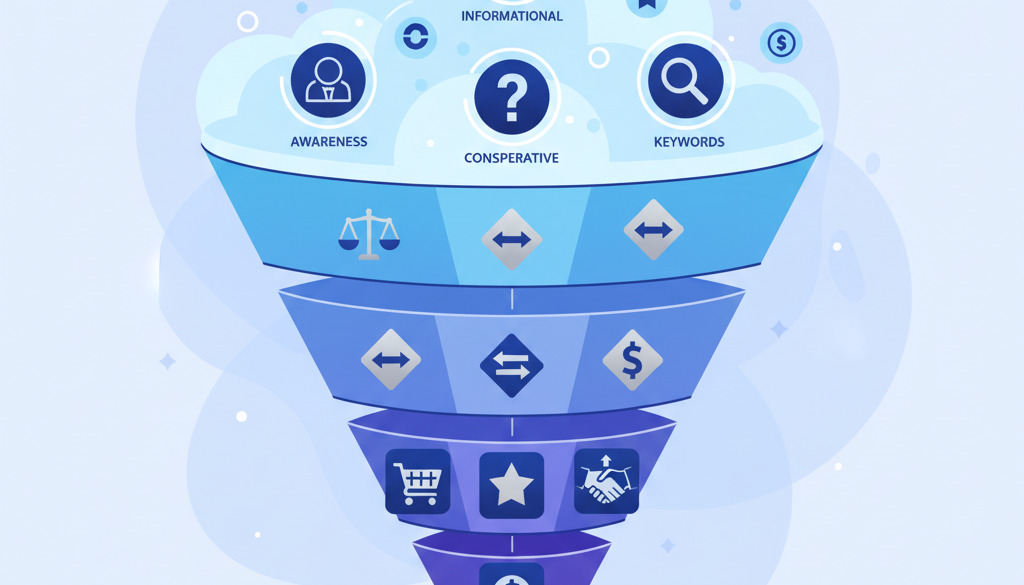
Buyer intent typically falls into three main categories, each aligning with a different stage of the customer journey:
- Informational Intent: The user is seeking information. They have a problem or a question but are not yet considering specific products. Examples: "how to choose running shoes," "what are the benefits of minimalist running."
- Navigational Intent: The user wants to find a specific website or brand. They already know where they want to go. Examples: "Shopify login," "Nike official website."
- Transactional Intent: The user is ready to make a purchase or take a commercial action. These are the highest value keywords for an e-commerce store. Examples: "buy brooks glycerin 21," "best price on hoka clifton 9," "running shoe store near me."
Focusing solely on high-volume, informational keywords without a strategy to capture transactional intent is like filling a bucket with holes. You'll see a lot of activity but end up with very little to show for it.
The Cost of Ignoring Intent
When you fail to align your content with buyer intent, you create a disjointed customer experience. A user with transactional intent who lands on a long-form informational blog post is likely to leave. Conversely, a user at the beginning of their journey who is only met with product pages will feel pressured and exit. This mismatch leads directly to high bounce rates, low conversion rates, and a poor return on your SEO investment.
SEO Fundamentals for E-commerce Success
Before diving into the advanced strategies of AI and buyer intent, it's critical to have a firm grasp of the fundamentals. Search Engine Optimization is the bedrock of your store's discoverability, and it can be broken down into three core pillars.[1]
On-Page, Off-Page, and Technical SEO
- On-Page SEO: This involves optimizing the elements *on* your website. This includes the quality of your content, the strategic use of keywords in titles, headers (H1, H2, etc.), and body text, as well as optimizing your meta descriptions to encourage clicks from search results.
- Off-Page SEO: These are optimization factors that occur *off* your website. The most significant factor is backlinks—links from other reputable websites to yours. These act as votes of confidence, telling search engines that your content is valuable and trustworthy. Social media signals and brand mentions also fall under this category.
- Technical SEO: This ensures that search engine crawlers can efficiently access, understand, and index your website. Key aspects include site speed, mobile-friendliness, a secure connection (HTTPS), and having a clean sitemap and site structure.
A successful SEO strategy requires a balanced approach that addresses all three pillars. Neglecting one will undermine the effectiveness of the others.
The Power of Shopify for E-commerce Businesses
Shopify has emerged as a dominant force in the e-commerce world for good reason. It provides a robust, user-friendly platform that allows entrepreneurs and small to medium-sized business (SMB) owners to build and scale their online stores without needing to be master coders. Its intuitive interface, vast app ecosystem, and secure checkout process make it an ideal choice for businesses focused on growth.

For a business owner who isn't a web developer by trade—perhaps someone over 40 who knows their industry inside-out but finds the online world daunting—Shopify removes immense technical barriers. A well-configured Shopify store provides a strong foundation upon which a powerful, buyer-intent-focused SEO strategy can be built, creating a direct path for customers to find you through Google.
Introducing Buyer Intent SEO: A Strategic Approach for Shopify Stores
Buyer intent SEO is a strategic filter applied over your entire SEO effort. It's not a replacement for the fundamentals, but an advanced methodology that prioritizes attracting users who are not just browsing, but actively moving towards a purchase. Instead of chasing vanity metrics like raw traffic numbers, the primary goal is to **increase qualified, high-converting traffic**.
Within your Shopify store, this means meticulously mapping content to intent. For example:
- Blog posts might target informational keywords like "how to care for leather boots."
- Category pages might target keywords with investigational or comparative intent, like "best waterproof leather boots for winter."
- Product pages must be laser-focused on transactional keywords like "buy Red Wing Iron Ranger boots size 10."
Adopting this mindset gives you a significant competitive advantage. While your competitors are fighting for broad, low-intent keywords, you are creating a direct and efficient funnel for paying customers.
Leveraging AI for Advanced Buyer Intent Analysis
Manually trying to determine the intent behind thousands of keyword variations is an impossible task. The nuances are too subtle, and the volume of data is too vast. This is where Artificial Intelligence becomes not just a luxury, but a necessity. AI algorithms can analyze millions of search queries, user behavior patterns, and search engine results pages (SERPs) in seconds.
What AI Can See That Humans Can't
AI tools can detect patterns that indicate intent with incredible accuracy. They can understand semantic relationships between words, recognize the significance of modifiers (like "buy," "review," "cheap," "near me"), and correlate this data with user engagement metrics. An AI can determine that searches for "how to fix a leaky faucet" have informational intent, while "plumber in brooklyn emergency" has urgent transactional intent, and do so across countless product and service categories instantly.
AI-Powered Keyword Research for Buyer Intent
The biggest shift AI brings to keyword research is the move away from a myopic focus on high search volume. Instead, AI prioritizes *high-intent* keywords, even if their search volume is lower. These are often long-tail keywords—longer, more specific phrases that, while searched less frequently, have a much higher conversion rate.
From Broad to Profitable
An AI-powered SEO tool can help a Shopify store owner identify these golden nuggets. For example, instead of targeting the highly competitive term "coffee beans," an AI might suggest targeting:
- "buy single origin Ethiopian coffee beans online" (Transactional)
- "best low-acid coffee beans for sensitive stomach" (Informational, leading to a purchase)
- "fresh roasted coffee bean subscription box" (Transactional, recurring revenue)
This level of specificity allows you to create highly relevant content and product pages that perfectly match the user's needs, dramatically increasing the likelihood of a sale.
Crafting High-Converting Content with AI: The More Customers From Your Blog Advantage
Herein lies the greatest challenge for most SMB owners: you know you need high-quality blog content for SEO, but who has the time? You're busy running your business, managing inventory, and serving customers. You're an expert in your field, not a professional writer, and the thought of writing a 4,000-word blog post is exhausting.
This is where a solution like **More Customers From Your Blog** becomes a game-changer. It's a service built specifically for busy entrepreneurs who understand the importance of online content but lack the time or inclination to create it themselves. Our proprietary artificial intelligence is designed to write professional, SEO-optimized blog articles for your website in minutes, not days. We've taken the complex process of identifying buyer intent and crafting relevant articles and automated it, making it feel almost like magic.
By leveraging such a service, you ensure a steady stream of unique, relevant content flows to your Shopify blog, consistently attracting new customers from Google without you having to write a single word. With over 500 companies already using the system, it
Keep reading
Hand-picked guides that go deeper — open the one you need next:
- E-commerce Blog Automation: The Smart Way to Grow Your Store
- Shopify Buyer Intent Content: A Master Strategy Guide
- Increase Shopify Sales with AI-Driven Buyer Intent Blog Posts
- Shopify Blog SEO: Growth Strategies for Small Business
→ Read the full Shopify & Ecommerce guide
→ Read the full Shopify & Ecommerce guide