
Skyrocket Shopify Sales: AI & Buyer Intent SEO

Key Takeaways
- Beyond Keywords: Modern SEO for Shopify has moved past simple keyword density. Success now hinges on understanding and matching buyer intent—the "why" behind a search.
- Four Tiers of Intent: Customers search with informational, navigational, commercial investigation, or transactional intent. Targeting the last two is critical for driving sales.
- AI as a Force Multiplier: Artificial Intelligence can analyze vast datasets to uncover high-intent keywords and content opportunities that manual research often misses, giving you a significant competitive edge.
- Content at Scale: AI-powered tools can generate high-quality, SEO-optimized blog posts and product descriptions in minutes, solving the content creation bottleneck for busy business owners.
- Data-Driven Optimization: AI not only helps create content but also analyzes its performance, providing clear insights into what drives conversions and where to focus your efforts.
- Human Oversight is Key: The best results come from a partnership between human strategy and AI execution. Your expertise guides the AI to ensure content is authentic, on-brand, and truly valuable.
The Shifting Sands of E-commerce Search: Why Traditional SEO Isn't Enough for Shopify
In the bustling digital marketplace, getting your Shopify store to stand out is a monumental task. For years, the prevailing wisdom in search engine optimization (SEO) was a numbers game centered around keywords.[1] The formula seemed simple: identify a popular search term and repeat it throughout your website. This strategy, known as keyword stuffing, is now a relic of a bygone era. As noted in Shopify's own expert guidance, obsessing over keyword density no longer works and can even penalize your store.
Today's search engines, led by Google, have evolved into sophisticated platforms that prioritize user experience above all else. Their algorithms are designed to understand the context and, most importantly, the intent behind every search query. Simply ranking for a generic keyword like "running shoes" is no longer a guarantee of success. If a user is searching for "best running shoes for flat feet," a generic page will lose to a competitor that directly addresses that specific need. This fundamental shift means that for Shopify store owners, the goal is not just to attract traffic, but to attract qualified traffic—visitors who are actively looking to make a purchase.
The modern challenge isn't just being found; it's about being found by the right person at the exact moment they are ready to buy. This requires a deeper, more nuanced approach that goes far beyond traditional SEO tactics.
Understanding Buyer Intent: The Compass for Your Shopify SEO Strategy
At its core, buyer intent (also known as user intent or search intent) is the primary goal a user has when they type a query into a search engine. Understanding this intent is the compass that guides your entire SEO and content strategy. By aligning your content with a user's intent, you create a seamless journey from discovery to purchase. For an e-commerce business, this alignment is the difference between a casual browser and a loyal customer.
Buyer intent is typically categorized into four main types:
- Informational Intent: The user is looking for information. They have a question or want to learn more about a topic. Examples include "how to clean leather boots" or "what are the benefits of vitamin C serum."
- Navigational Intent: The user wants to find a specific website or page. They already know where they want to go. For example, "Shopify login" or "Nike official website."
- Commercial Investigation Intent: The user is in the consideration phase. They intend to buy a product or service in the near future and are currently comparing options, reading reviews, or looking for the best solution. Searches like "best Shopify themes for clothing stores" or "AirPods Pro vs Sony WF-1000XM4" fall into this category.
- Transactional Intent: The user is ready to buy. Their search query includes strong purchase signals like product names, brand names, or words like "buy," "price," "discount," or "sale." Examples are "buy iPhone 15 Pro" or "men's large black t-shirt."
For any Shopify store, the holy grail is capturing traffic from users with commercial investigation and transactional intent. These individuals are not just browsing; they are actively moving down the sales funnel, and your goal is to ensure your store is the one that meets them at the finish line.
Decoding the Searcher's Mindset: Tools and Techniques for Intent Analysis
Identifying buyer intent isn't just guesswork; it's a data-driven process. The key is to look beyond the surface level of a keyword and analyze the context surrounding it.
Keyword Research with Intent in Mind
Your approach to keyword research must evolve. Instead of just targeting high-volume keywords, focus on long-tail keywords (phrases of three or more words) and question-based queries. These longer phrases are often more specific and carry clearer intent. For example, a user searching for "shoes" has vague intent, but a user searching for "buy women's size 8 waterproof hiking boots" has clear transactional intent.
A critical technique is to analyze the Search Engine Results Pages (SERPs) for your target keywords. What kind of content is Google currently ranking? Are they product pages, blog posts, review articles, or video tutorials? The SERP is Google telling you precisely what kind of content it believes satisfies the intent for that query. If the top results are all "how-to" guides, creating a product page for that keyword will likely fail.
The Power of AI in Uncovering Real-Time Buyer Intent for Shopify
Manually analyzing SERPs and brainstorming long-tail keywords is a valid but incredibly time-consuming strategy. For a business owner who is also managing inventory, marketing, and customer service, it's often an impossible task. This is where Artificial Intelligence (AI) emerges as a transformative tool for Shopify SEO.[2]
AI algorithms can process enormous amounts of data—from search trends and competitor websites to social media conversations and customer reviews—at a scale and speed no human can match. This allows AI to identify subtle patterns and predict user behavior with remarkable accuracy. Instead of just looking at historical keyword data, AI can tap into real-time buyer interests and emerging trends, giving you a powerful first-mover advantage.
More importantly, AI goes beyond simple keyword matching. It employs Natural Language Processing (NLP) to understand the nuances, context, and sentiment of search queries. It can differentiate between a user asking "how does a smart thermostat work?" (informational) and "Google Nest thermostat vs Ecobee price" (commercial investigation), enabling you to create perfectly targeted content for each stage of the buyer's journey.
AI-Powered Keyword Discovery: Beyond the Obvious
One of the most significant advantages of using AI is its ability to uncover high-intent, low-competition keyword opportunities that are invisible to traditional research methods.
Identifying High-Intent Opportunities
AI can sift through forums, Q&A sites, and product reviews to find the exact language your potential customers are using when they are close to making a purchase. This uncovers "purchase-ready" keywords you would have never thought to target. For instance, AI might identify that users searching for a specific type of craft supply also frequently ask about "non-toxic" and "quick-drying" features. By incorporating these terms into your product descriptions and blog content, you directly address a crucial buying consideration before the customer even has to ask.
Crafting Content That Converts: AI-Assisted Content Creation for Shopify
Knowing which keywords to target is only half the battle. You still need to create high-quality, engaging content that satisfies the user's intent. For many established business owners, this is the biggest hurdle. You know your business is important, and you know online content is the key, but you have neither the time nor the desire to become a professional writer and SEO expert.
This is where AI-driven content generation provides a revolutionary solution. Modern AI platforms can create well-written, relevant, and SEO-optimized content at an incredible scale. This isn't about creating robotic, soulless text. It's about using AI as a powerful assistant that takes your business goals and product information and translates them into compelling content that resonates with your target audience. AI doesn't replace your business strategy; it augments it, allowing you to execute a world-class content plan without the massive time investment.
From Data to Data-Driven Content: How AI Generates Winning Shopify Blog Posts
The process of using AI for content creation is surprisingly straightforward and incredibly effective. It turns the abstract concept of "buyer intent" into a tangible, high-performing asset for your store.
The AI Content Workflow for Shopify
Typically, the workflow involves providing the AI with a few key inputs: your product or service, your target audience, and the desired buyer intent you want to address. The AI then analyzes this information and can generate a wealth of content resources:
- Topic Ideas: Suggesting blog post titles that are proven to attract clicks from your target demographic.
- Content Outlines: Structuring an article to flow logically and cover all the key points a potential customer is looking for.
- Full Drafts: Generating complete articles that answer specific customer questions, address pain points, and subtly guide them towards your products.
This is where services designed to get More Customers From Your Blog truly shine. By inputting basic information about your products and goals, their specialized AI can craft professional SEO articles in minutes. This automates the most time-consuming part of content marketing, freeing you up to focus on running your business. It’s a powerful way to ensure your Shopify store is consistently publishing content that attracts search traffic and converts visitors into buyers.
Optimizing Shopify Product Pages for Transactional Intent
While blog content is crucial for attracting users in the informational and investigation stages, your product pages are where the final conversion happens. These pages must be perfectly optimized to capture users with high transactional intent.
This goes beyond simply listing features. Your product pages must scream "buy me" by showcasing clear unique selling propositions (USPs), building trust, and creating a sense of urgency. Elements like high-quality images, customer reviews, clear shipping and return policies, and compelling calls-to-action (CTAs) are non-negotiable.
AI can play a significant role here by analyzing thousands of top-performing competitor product pages and customer reviews across the web. It can identify the specific words, phrases, and value propositions that are most effective at driving conversions in your specific niche, giving you a data-backed roadmap for optimization.
AI's Role in Enhancing Product Descriptions and Meta Data
Your product descriptions and the hidden "meta" data are prime real estate for targeting transactional intent. Generic, manufacturer-supplied descriptions are a recipe for failure.
Writing Compelling, Intent-Focused Descriptions
Using its understanding of natural language, AI can help you craft product descriptions that do more than just describe—they sell. An AI assistant can:
- Address Buyer Needs: Weave in answers to common questions and solutions to pain points directly into the description.
- Overcome Objections: Proactively address potential concerns a buyer might have (e.g., "Is it durable?", "Is it easy to use?").
- Optimize for Search: Seamlessly integrate transactional keywords (like "buy," "deal," "fast shipping") into the text and meta descriptions to attract purchase-ready clicks from Google.
By using AI to refine this critical content, you ensure that when a user with high buying intent lands on your page, everything they read reinforces their decision to purchase from you.
Leveraging AI for Informational and Commercial Investigation Content on Shopify
While transactional queries drive immediate sales, ignoring the earlier stages of the buyer journey is a massive missed opportunity. Attracting users with informational and commercial investigation intent allows you to build brand awareness, establish authority, and create a pipeline of future customers.
This is where a strong blog strategy becomes invaluable. By creating helpful guides, in-depth comparisons, and "how-to" articles, you become a trusted resource in your industry. When that user is eventually ready to make a purchase, your store will be the first one they think of.
AI is exceptionally good at identifying content gaps and opportunities in these upper-funnel stages. It can analyze what questions people are asking in your niche that your competitors aren't answering, allowing you to create content that fills that void and captures valuable, early-stage traffic.
AI-Driven Topic Ideation for Top-of-Funnel (TOFU) and Middle-of-Funnel (MOFU) Content
Building a content calendar that effectively targets these users can be daunting. AI simplifies this process by providing data-driven topic ideas.
Building Authority and Trust
An AI-powered system can help you systematically build authority and guide users through the funnel in several ways:
- Identify Trending Topics: AI can spot rising trends and common questions related to your products, allowing you to create timely and relevant content.
- Generate Comprehensive Outlines: For complex topics like "A Beginner's Guide to..." or "Product A vs. Product B," AI can generate detailed outlines ensuring your content is thorough and truly helpful.
- Ensure Accuracy and Relevance: By analyzing top-ranking content, AI helps you create articles that are more comprehensive and directly answer a user's query better than the competition.
Again, this is where an AI-powered service that generates professional, SEO-optimized blog posts becomes a strategic asset. It allows you to consistently publish the high-quality informational and comparison content needed to draw qualified buyers to your site, effectively building a relationship with them long before they are ready to click "add to cart."
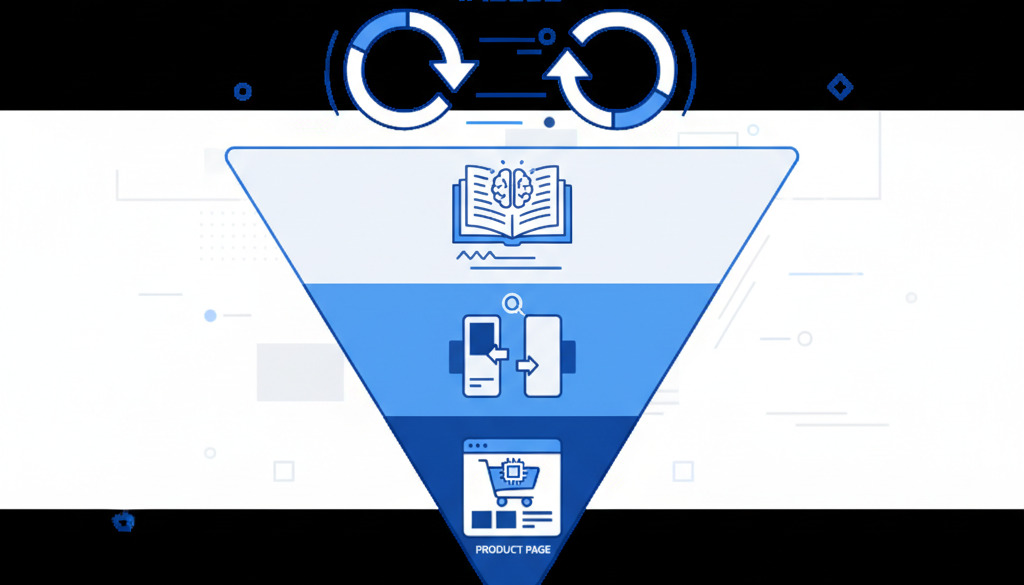
The AI Advantage: Measuring and Refining Buyer Intent SEO for Shopify
SEO is not a "set it and forget it" activity. To maintain and improve your rankings, you need to continuously monitor your performance and refine your strategy. AI provides a significant advantage in this analytical phase as well.
While standard tools like Google Analytics provide raw data, AI can interpret that data to deliver actionable insights. It can connect the dots between your content, search rankings, and actual sales, helping you understand the real-world ROI of your SEO efforts. Instead of getting lost in a sea of metrics, AI helps you focus on the ones that truly matter for measuring buyer intent success, such as conversion rates from specific blog posts, the user journey from an informational article to a product page, and the bounce rates on high-intent pages.
Data Analytics and AI: A Powerful Partnership for Shopify Growth
When you pair AI with your analytics, you unlock a powerful feedback loop for continuous improvement. This partnership helps you pinpoint exactly what is working and what isn't.
Key Metrics for Buyer Intent Success
An AI-enhanced analytics approach allows you to track and optimize for highly specific success signals. Below is a table illustrating the shift from traditional metrics to intent-focused metrics.
| Traditional Metric | AI-Powered, Intent-Focused Metric | Why It Matters |
|---|---|---|
| Overall Traffic | Traffic to Transactional & Commercial Pages | Focuses on the visitors most likely to convert, not just raw numbers. |
| Keyword Rankings | Conversion Rate per Keyword | Reveals which keywords are actually driving sales, not just vanity rankings. |
| Bounce Rate | User Flow from Blog to Product Page | Shows if your informational content is successfully guiding users towards a purchase. |
| Pages per Session | Time on Page for Comparison Guides | Indicates deep engagement on high-consideration content. |
Integrating AI SEO into Your Shopify Workflow: Practical Steps
Adopting an AI-powered SEO strategy might sound complex, especially for a busy business owner who isn't a digital native. However, the beauty of modern AI tools and services is that they are designed for accessibility. You don't need to be a data scientist to leverage their power. The key is to start with a clear, simple plan and scale your efforts as you see results.
The goal is not to replace your entire workflow overnight but to strategically integrate AI where it can have the most impact—saving you time, generating better ideas, and creating more effective content. It’s about working smarter, not harder, to achieve your online growth goals.
Getting Started with AI for Your Shopify Store's SEO
For a business owner who knows online content is vital but lacks the time, here is a practical, phased approach to getting started.
A Phased Approach
- Define Your Initial Goal: Don't try to do everything at once. Start with a single, clear objective. Is it to increase traffic to your top 5 product pages? Or is it to rank for 3 specific "best [product type]" commercial investigation keywords?
- Choose the Right Tool or Service: Your choice should align with your primary pain point. If your biggest problem is a lack of time for writing, a content generation service is a perfect fit. Look for solutions that are easy to use and offer clear value.
- Start with a Pilot Project: Select a small part of your store—perhaps one product category—and apply your AI strategy there. Measure the results over a month or two.
Many platforms recognize the need for a low-risk entry point. For instance, services designed to bring more customers to your blog from search engines often provide a free trial. Some allow you to generate your first 5 posts completely free, making it a no-risk way to experience the power and quality of AI-driven SEO firsthand.
Overcoming Common Pitfalls in AI-Driven Shopify SEO
As with any powerful new technology, there are potential pitfalls and valid concerns. Some business owners worry that AI-generated content will be generic, sound robotic, or even be penalized by search engines. These are legitimate questions that a smart strategy must address.
The most significant pitfall is treating AI as a magic button that requires no human thought. The best results come not from blindly accepting whatever the AI produces, but from a collaborative process where the business owner’s expertise and brand knowledge guide the AI’s output. Avoiding generic content and maintaining a consistent brand voice requires this essential human touch.
The Human Touch: Guiding AI for Optimal Shopify Results
Think of AI not as an outsourced writer, but as the world’s most efficient and knowledgeable junior assistant. It does the heavy lifting, but you provide the final direction and quality control.
Ensuring Quality and Relevance
- You are the Editor-in-Chief: Always review AI-generated content. Tweak it to match your brand’s unique voice, add personal anecdotes or industry insights, and ensure its factual accuracy. This human layer is what elevates good content to great content.
- Maintain Authenticity: Your customers connect with your brand for a reason. Your content should reflect that unique personality. The AI provides the structure and the SEO-optimized foundation; you provide the soul.
- Strategic Direction: The AI is a tool. You are the strategist. You decide which products to promote, which customer pain points to address, and what your brand’s core message is. This strategic guidance ensures the AI is always working toward your specific business goals.

The Future of Shopify Growth: AI, Intent, and Hyper-Personalization
The integration of AI into Shopify SEO is not a fleeting trend; it is the future of e-commerce. As the technology continues to evolve, its ability to understand buyer intent will become even more granular and powerful. We are moving towards a future of hyper-personalization, where AI can help tailor content and user experiences to an individual visitor’s needs in real-time.
Imagine a Shopify store that dynamically adjusts its homepage content based on whether a visitor arrived from a search for "cheap running socks" versus "marathon training gear." This level of personalization, driven by an AI’s deep understanding of intent, will create unparalleled customer experiences and drive conversion rates to new heights.
Anticipating the Next Wave: Proactive Strategies for Evolving AI in SEO
The businesses that will thrive in this new era are the ones that embrace a mindset of continuous learning and adaptation. Staying ahead of the curve means not just using today’s AI tools but also anticipating how they will evolve tomorrow.
Staying Ahead of the Curve
The ultimate goal of this technological evolution is to create a completely seamless and intuitive customer journey. Proactive strategies will involve:
- Continuous Learning: Paying attention to advancements in AI and search algorithms.
- Predictive Analytics: Using AI not just to analyze past behavior but to predict future search trends and customer needs.
- Focusing on the Customer: Remembering that technology is just a means to an end. The end goal is always to better serve the customer by answering their questions, solving their problems, and providing them with the products they need.
Conclusion
For Shopify store owners, the path to sustainable growth is no longer paved with outdated SEO tricks. The digital landscape now rewards a deeper understanding of your customers—their questions, their needs, and their intent to buy. Marrying this focus on buyer intent with the power of Artificial Intelligence is the single most effective strategy for increasing qualified traffic, boosting conversion rates, and creating an efficient, scalable engine for growth.
This advanced approach is no longer reserved for large corporations with massive marketing teams. As we've explored, AI has democratized high-level SEO, making it accessible even for established business owners with limited time and resources. By leveraging AI to uncover what your customers truly want and to create the content that meets those needs, you can transform your Shopify store from just another e-commerce site into a go-to destination for purchase-ready buyers.
The first step on this transformative journey is often the easiest. We encourage you to explore how AI-driven content creation can become your secret weapon. Platforms that exist to get more customers from your blog can be the perfect starting point, demonstrating just how quickly you can begin populating your site with professional, high-intent articles that drive real business results.
Frequently Asked Questions
- 1. Is AI-generated content safe for SEO? Will Google penalize my site?
- Yes, it is safe when done correctly. Google's official stance is that it rewards high-quality content, regardless of how it's produced. The key is to use AI as a tool to create relevant, helpful, and user-centric content, not to generate spam. Human oversight and editing are crucial to ensure the final product meets these quality standards.
- 2. I'm not a technical person. Is this difficult to set up and use?
- Not at all. Modern AI SEO and content platforms are specifically designed for users who are not technical experts, like busy business owners. Many services feature intuitive interfaces where you simply input your topic or product information, and the AI handles the complex work. Services that offer free trials are a great way to test the process without any commitment.
- 3. Can I use AI for my Shopify product descriptions, not just blog posts?
- Absolutely. Using AI to write or enhance your product descriptions is one of its most powerful applications. AI can help you craft unique, compelling descriptions that incorporate transactional keywords, answer common customer questions, and highlight the key benefits that lead to a purchase.
- 4. How can I figure out the "buyer intent" behind a specific keyword?
- A simple and effective method is to search for the keyword on Google and analyze the top 10 results. Are they blog posts (informational), product category pages (commercial/transactional), or specific product pages (transactional)? The type of content Google ranks is a strong signal of what it believes users want to see.
- 5. Won't my content sound robotic if an AI writes it?
- This is a common concern, but modern AI is incredibly sophisticated. While a first draft might sometimes lack a certain flair, it provides a strong, well-structured foundation. The best practice is to always perform a final review and edit, injecting your brand's unique personality and voice. This human-AI partnership results in content that is both optimized for search and authentic to your brand.
- 6. How much does an AI content service typically cost?
- Costs can vary widely, from monthly subscriptions to pay-per-article models. However, the goal is for the service to provide a positive return on investment by saving you dozens of hours and driving sales. Many platforms offer accessible entry points, such as free trials or introductory packages (e.g., getting your first 5 articles for free) so you can prove its value before making a significant investment.
Keep reading
Hand-picked guides that go deeper — open the one you need next:
- Shopify Blog SEO: Growth Strategies for Small Business
- Shopify Blog SEO Secrets: How AI Generates Buyer-Intent Content for More Sales
- Mastering Shopify Buyer Intent Content for Higher Sales
- Shopify AI Blog Content: A Strategic Guide for Merchants
→ Read the full Shopify & Ecommerce guide
→ Read the full Shopify & Ecommerce guide