
The Traffic Quiz: See How Much You're Missing with Current
Key Takeaways
- SEO performance is not optional: It directly impacts your visibility, lead generation, and long-term brand authority. Ignoring it means leaving potential customers and revenue on the table.
- Success lies in the details: Effective SEO is a combination of keyword strategy, on-page optimization, technical soundness, quality content, and a seamless user experience.
- Self-assessment is the first step: You cannot fix what you do not measure. This article includes a comprehensive self-assessment quiz to help you pinpoint weaknesses in your current strategy.
- Content is a major hurdle (with a solution): Many business owners lack the time and resources for consistent content creation, a critical SEO factor. AI-powered services now offer a viable, efficient solution to this problem.
- Continuous effort wins: SEO is not a "set it and forget it" task. It requires ongoing attention and adaptation to maintain and grow your online presence.
What is SEO Performance and Why Does It Matter for Your Business?
As a business owner, you are an expert in your field. You know your product, your service, and your customers. But in today's digital-first world, there's another critical component to success: your online visibility. SEO performance is the measure of how effectively your website attracts organic, unpaid traffic from search engines like Google.[2] It's not about technical wizardry for its own sake; it's about tangible business outcomes.
Think of it this way: your website can be a 24/7 salesperson, or it can be a glossy brochure hidden in a filing cabinet. Strong SEO performance turns it into that tireless salesperson. When potential customers in your area search for solutions you provide, effective SEO ensures your business shows up as a top result. This is fundamentally different from paid advertising, where your visibility disappears the moment you stop paying.
The benefits are direct and substantial:
- Increased Customer Acquisition: More visibility means more potential customers discovering your business right at the moment they need you.
- Reduced Marketing Costs: Organic traffic is "free" in the sense that you don't pay per click. Investing in SEO yields long-term returns that can far outweigh the cost-per-acquisition of paid ads.
- Enhanced Brand Authority and Trust: Ranking high on Google signals to users that you are a credible and authoritative voice in your industry. People inherently trust organic results more than sponsored ones.
Ultimately, measuring and improving your SEO performance is about ensuring your business is not just surviving online, but thriving and capturing the growth it deserves.
The Foundation of Your Online Presence: Keyword Strategy Effectiveness
Everything in SEO starts with keywords. These are the words and phrases your potential customers type into Google when they are looking for the products or services you offer. A successful keyword strategy is built on understanding not just what people are searching for, but why. This is known as search intent.
Aligning Keywords with Business Offerings and Customer Intent
Your keyword list should be a perfect mirror of your business offerings. If you are a plumber in Chicago specializing in emergency repairs, your keywords need to reflect that. Targeting a broad term like "plumbing" is a common mistake; it's highly competitive and doesn't capture the user's specific need.
A successful keyword strategy isn't about attracting the most traffic; it's about attracting the right traffic. You want visitors who are actively seeking the solutions you provide, as they are far more likely to convert into customers.
Avoiding Common Pitfalls: Broad vs. Specific Keywords
Many small and medium-sized enterprises (SMEs) fall into the trap of targeting "vanity" keywords—single, broad words with massive search volumes. While it seems appealing, the reality is that these terms are incredibly difficult to rank for and often have vague user intent. Someone searching for "cars" could be a student doing research, not a person ready to buy. However, someone searching for "used Honda CR-V under $20,000 near me" has clear commercial intent.
The Power of Long-Tail Keywords
This leads us to the value of long-tail keywords. These are longer, more specific search phrases (typically three or more words) that have lower search volume but much higher conversion rates. Think back to our plumber example. Targeting "emergency burst pipe repair Chicago" is a long-tail keyword. The person searching this is not browsing; they have an urgent problem and are looking for an immediate solution. For a seasoned business owner, these are the most valuable searches to capture.
On-Page Optimization: Making Your Content Search-Engine Friendly
Once you know which keywords to target, the next step is to ensure your website's pages are structured in a way that both search engines and users can understand. This is the practice of on-page SEO, and it involves optimizing the elements directly on your web pages.
Crafting Compelling Title Tags and Meta Descriptions
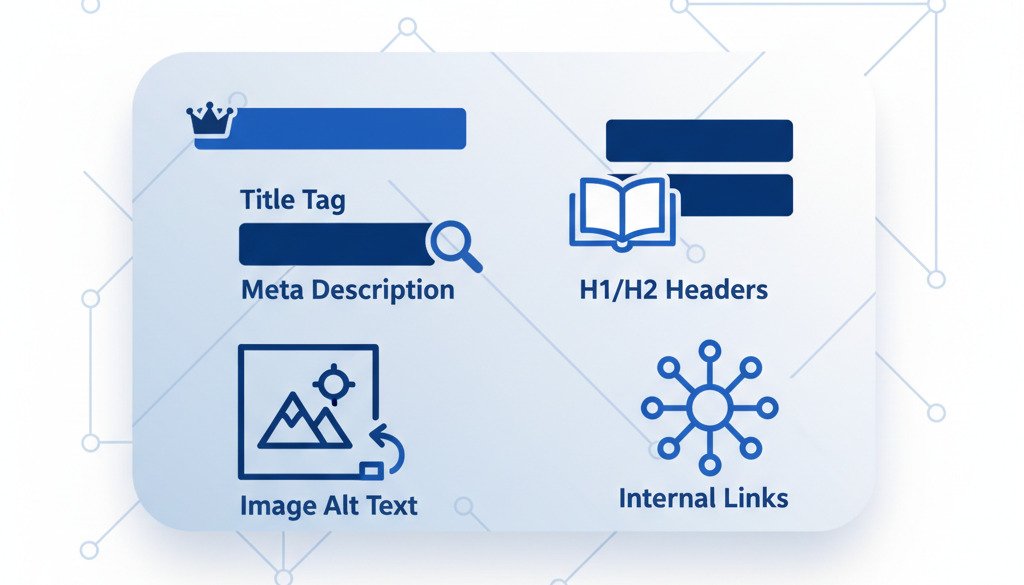
Your title tag is the blue clickable headline that appears in Google search results, while the meta description is the short descriptive text beneath it. These are your first impression and your sales pitch. A good title tag should be clear, concise (under 60 characters), and include your primary keyword. An effective meta description (under 160 characters) should expand on the title, include a call-to-action, and entice the user to click on your result instead of a competitor's.
Structuring Content with Header Tags (H1, H2, etc.)
Headers (like the ones in this article) provide a clear hierarchy for your content. Your main title should be an H1 tag. Major subtopics should be H2s, and further sub-points should be H3s. This doesn't just make the content easier for humans to read; it provides a crucial roadmap for search engines to understand the structure and main topics of your page.
The Importance of High-Quality, Readable Content
The words on your page are the main event. Google prioritizes content that is comprehensive, well-written, and genuinely helpful to the user. This means writing in clear, natural language and integrating your target keywords in a way that feels organic, not forced or "stuffed." Short, choppy paragraphs and bulleted lists improve readability and keep visitors engaged.
Image Optimization and Internal Linking
Images can slow down your site if they aren't optimized. Make sure they are compressed for the web. Also, every image should have descriptive alt text, which tells search engines what the image is about and helps visually impaired users. Furthermore, internal links—links from one page on your site to another—help search engines discover more of your content and help users navigate your site, keeping them engaged longer.
Off-Page Signals: Building Authority and Trust Beyond Your Website
While on-page SEO is about what's on your site, off-page SEO is about the signals of trust and authority your site has garnered from other places on the internet. Google wants to recommend sites that are not just relevant but also reputable, and off-page signals are how it gauges that reputation.
The Currency of the Web: Quality Backlinks
The most significant off-page signal is your backlink profile. A backlink is a link from another website to yours. Think of it as a vote of confidence or a referral. However, not all backlinks are created equal. A link from a respected industry publication or a local chamber of commerce website is far more valuable than a link from a low-quality, spammy directory. The goal is to earn quality links from relevant and authoritative sources.
The Dangers of Poor Linking Strategies
In the past, some tried to trick search engines by buying thousands of low-quality links. Today, this is a recipe for disaster. Google's algorithms are sophisticated and can easily detect such schemes, often resulting in a penalty that can make your site disappear from search results entirely. Earning links naturally—by creating valuable content that others want to cite—is the only sustainable strategy.[1]
Brand Mentions, Reviews, and Local Citations
Off-page SEO isn't just about links. Google also looks at other signals. When your brand is mentioned online (even without a link), it contributes to your authority. Online reviews on platforms like Google Business Profile, Yelp, and industry-specific sites are incredibly important, especially for local businesses. Finally, citations—mentions of your business Name, Address, and Phone number (NAP) on various online directories—help solidify your location and legitimacy for local search.
Technical SEO: The Unseen Backbone of Your Website's Discoverability
If on-page SEO is the content of your house and off-page SEO is its reputation in the neighborhood, then technical SEO is the foundation, plumbing, and electrical wiring. It's the unseen infrastructure that allows search engines to find, crawl, and index your website without issues. For many business owners, this can sound intimidating, but understanding the core concepts is essential.
Website Speed and Mobile-Friendliness
Two of the most critical technical factors today are site speed and mobile-friendliness. Users expect websites to load quickly—typically within 3 seconds. A slow site leads to a high bounce rate (people leaving immediately), which signals to Google that users are having a poor experience. Furthermore, since the majority of searches now happen on mobile devices, Google uses a "mobile-first" indexing approach. This means if your site isn't easy to use on a smartphone, your rankings will suffer everywhere.
Crawlability and Website Structure
Search engines use automated programs called "crawlers" or "spiders" to discover and read the content on your website. A clean, logical site structure with clear navigation makes it easy for these crawlers to find all of your important pages. A confusing structure can lead to pages being missed or "orphaned," making them invisible to search engines.
Sitemaps and Robots.txt
You can help guide search engines with two key files. A sitemap is literally a map of your website—an XML file that lists all your important URLs, telling Google "Here are the pages I want you to index." Conversely, a robots.txt file tells search engines which pages or sections of your site to avoid crawling, such as administrative login pages or internal documents.
Content Depth and Relevance: Engaging Your Audience and Search Engines
In the early days of the internet, a simple 300-word page was enough. Today, the standard is much higher. Search engines, especially Google, are increasingly prioritizing content that demonstrates expertise, authority, and trustworthiness (a concept known as E-A-T). This means creating content that is not only relevant to a user's query but also comprehensive and genuinely answers their questions.
The Shift to Authoritative, Comprehensive Content
Instead of creating dozens of short, superficial blog posts, the modern approach is to create "pillar" content or cornerstone articles. These are long-form, in-depth guides that cover a topic extensively. For example, instead of a short post on "Choosing a Lawn Mower," a company might create a 4,000-word guide titled "The Ultimate Guide to Lawn Care for Homeowners," which covers mowers, fertilization, watering schedules, and pest control. This single piece of content can rank for dozens of related long-tail keywords.
Building Topical Authority
When you consistently create deep, high-quality content around a specific set of related topics, you build topical authority. You are signaling to Google that you are an expert in this particular niche. A website with 20 in-depth articles about home plumbing will be seen as more authoritative on that topic than a general contracting website that has only one page about plumbing. This authority makes it easier for all your pages within that topic to rank higher.
The Importance of Freshness and Updates
Content is not a one-and-done effort. Information becomes outdated, and search engines value "fresh" and recently updated content. Regularly reviewing and updating your key articles—by adding new information, updating statistics, or replacing broken links—signals to Google that your content is still relevant and valuable, which can help maintain or even boost its rankings.
User Experience (UX) Signals: How Visitors Interact With Your Site
Google’s primary goal is to provide its users with the best possible answer to their search query. This means they pay close attention to how users behave once they click on a search result. These user experience (UX) signals are indirect but powerful indicators of your page’s quality.
Critical Metrics: Bounce Rate, Time on Page, and CTR
- Click-Through Rate (CTR): This is the percentage of people who see your site in the search results and actually click on it. A low CTR might suggest your title tag and meta description aren't compelling enough.
- Bounce Rate: This is the percentage of visitors who leave your site after viewing only one page. A high bounce rate can indicate that the page content didn't match their expectations or that the page loaded too slowly.
- Time on Page (or Dwell Time): This measures how long a visitor stays on your page before returning to the search results. A longer dwell time signals that the user is engaged and finds your content valuable.
If a user clicks on your site and immediately "bounces" back to the Google search results to click on a different link, it’s a strong signal to Google that your page was not a good answer to their query. Over time, this can cause your ranking to drop.
Common UX Issues That Harm SEO
Poor user experience often stems from a few common culprits that business owners can easily overlook:
- Aggressive Pop-ups: Full-page pop-ups that appear the moment a user lands on a page are disruptive and can frustrate users, especially on mobile devices.
- Confusing Navigation: If users can't easily find what they're looking for, they won't stick around. Your main menu should be simple and logical.
- Poor Readability: Walls of dense text, tiny fonts, or low-contrast colors make content difficult to read. Use headings, short paragraphs, and plenty of white space.
Mobile-First Indexing and Responsive Design: Reaching Users Everywhere
The shift to mobile is no longer a future trend; it is the present reality. More Google searches take place on mobile devices than on desktops. In recognition of this, Google has implemented mobile-first indexing. This means Google predominantly uses the mobile version of your content for indexing and ranking. Effectively, your mobile site *is* your primary site in Google's eyes.

What Mobile-First Indexing Means for Your Business
This has a simple, profound implication: if your website provides a poor experience on a smartphone, your SEO performance will suffer across the board. It doesn’t matter if your desktop site is perfect. If the mobile version is slow, hard to read, or difficult to navigate, Google will rank your site based on that subpar experience. For any business, especially those serving local customers who are often searching on the go, a mobile-optimized site is non-negotiable.
The Solution: Responsive Web Design
The standard solution for this challenge is responsive design. A responsive website automatically adjusts its layout, content, and navigation to fit the screen size of the device it's being viewed on. Text becomes larger, buttons are spaced further apart for easy tapping, and complex menus are simplified. This ensures a seamless and positive user experience whether a visitor is on a 27-inch desktop monitor or a 6-inch phone screen. It eliminates the need to maintain a separate, dedicated "mobile site," which was a common but clunky practice in the past.
The Quiz: How Does Your Website Stack Up?
Now that you understand the key pillars of SEO performance, it's time for a self-assessment. The following quiz is designed to give you a quick, actionable snapshot of where you stand. Answer each question honestly based on your current website and marketing efforts. Give yourself the allotted points for each "Yes" answer.
Section 1: Keyword Strategy (Max 20 Points)
- Do you have a documented list of keywords you are targeting? (5 points)
- Does your keyword strategy include specific, multi-word long-tail keywords? (5 points)
- Have you researched what keywords your top 3 competitors are ranking for? (5 points)
- Do you know which keywords are currently bringing the most traffic to your site? (5 points)
Section 2: On-Page SEO (Max 25 Points)
- Does every important page on your site have a unique, optimized title tag (under 60 characters)? (5 points)
- Does every important page have a unique, compelling meta description? (5 points)
- Is your content structured with a single H1 tag and multiple H2/H3 tags? (5 points)
- Do you regularly add new, high-quality content (like blog posts) to your site? (5 points)
- Are your image files optimized for speed, and do they include descriptive alt text? (5 points)
Section 3: Technical SEO (Max 25 Points)
- Does your website load in under 3 seconds? (You can use Google's PageSpeed Insights tool to check.) (10 points)
- Is your website mobile-friendly and easy to use on a smartphone? (10 points)
- Have you submitted an XML sitemap to Google Search Console? (5 points)
Section 4: Off-Page SEO & Local SEO (Max 30 Points)
- Has your business been mentioned or linked to from other reputable websites (e.g., news sites, industry blogs, chamber of commerce)? (10 points)
- Is your Google Business Profile fully claimed and optimized with photos, hours, and services? (10 points)
- Do you have a system for encouraging customers to leave positive reviews online? (5 points)
- Is your business name, address, and phone number consistent across all online directories? (5 points)
Self-Assessment: Analyzing Your Quiz Results - Beginner Insights
If you scored 0-30 points, your website is likely experiencing a common problem: it's "invisible" on Google. You may have a beautiful website, but without the foundational elements of SEO, it’s not being discovered by search engines or potential customers. This is a critical issue, but it is also the easiest to begin fixing.
Your Immediate Action Plan
Don't be discouraged. A low score simply means you have the greatest opportunity for rapid improvement. Focus on these "easy wins":
- Fix Your Title Tags and Meta Descriptions: This is the lowest-hanging fruit in all of SEO. Go through your most important pages (homepage, service pages) and write unique, descriptive titles and metas using the guidelines from the On-Page SEO section.
- Claim and Optimize Your Google Business Profile: For any business with a physical location or service area, this is non-negotiable. It is free and is the single most important factor for ranking in local "map pack" results. Fill out every single section.
- Check Your Mobile-Friendliness: Use Google's own Mobile-Friendly Test tool. If your site fails, this becomes your #1 priority. Contact your web developer and make it clear that a responsive, mobile-friendly design is essential.
Your initial goal is not to rank #1 overnight. It is to build the basic foundation that allows Google to find, understand, and trust your website.
Self-Assessment: Analyzing Your Quiz Results - Intermediate Strategies
If you scored 31-65 points, you are on the right track. You’ve likely addressed some of the basics, and your site probably gets some sporadic organic traffic. However, your efforts are either inconsistent or incomplete, which is capping your growth potential. You are leaving a significant amount of traffic and customers on the table.
Your Path to Consistent Growth
Your focus should shift from just the basics to building authority and consistency.
- Start a Content Plan: Your biggest lever for growth is now content. Consistently publishing one high-quality, helpful blog post per month focused on your target keywords will dramatically improve your authority and rankings over time. Answer the questions your customers are always asking.
- Improve Your Internal Linking: Go back through your existing pages and blog posts. Wherever you mention a topic that is covered in-depth on another page, link to it. This helps distribute authority throughout your site and keeps users engaged longer.
- Conduct a Basic Competitor Analysis: Use free tools to see what keywords your top competitors are ranking for that you are not. This will give you a roadmap for new content ideas and show you where the gaps are in your own strategy.
Self-Assessment: Analyzing Your Quiz Results - Advanced Optimization
If you scored 66-100 points, congratulations. You have a solid grasp of SEO fundamentals and are likely seeing consistent results from your efforts. Your website is an asset that is actively generating traffic and leads. However, the world of SEO is competitive, and complacency is the enemy of growth. Your focus now is on advanced optimization and widening your competitive moat.
How to Dominate Your Market
At this level, gains are incremental but powerful. It's about refining and scaling what works.
- Perform a Content Gap and Audit: Identify which of your existing pages are underperforming and either update and improve them or remove them. Look for "keyword gaps"—topics your competitors rank for that you haven’t covered at all—and create new, superior content to target them.
- Pursue Strategic Link Building: Move beyond passive link earning. Actively reach out to complementary businesses, industry publications, or local organizations for guest posting opportunities or resource collaborations. Every high-quality backlink you build makes you harder to beat.
- Implement Schema Markup: This is a more advanced technique that involves adding structured data to your website’s code. It doesn't directly impact rankings, but it can help you win "rich snippets" in search results (like star ratings, FAQ drop-downs, or event info), which can dramatically increase your click-through rate.
Common SEO Performance Bottlenecks for SMEs
For most established business owners, particularly those over 40 who built their companies through skill and reputation, the challenge of SEO isn't a lack of desire; it’s a lack of a different, equally valuable resource: time. You understand the "why" but get stuck on the "how."
The most common bottlenecks we see for SMEs include:
- Lack of Time: You are busy running your actual business—managing employees, serving customers, and handling financials. You simply don't have 10-15 extra hours a week to dedicate to keyword research, content writing, and technical monitoring.
- Lack of In-House Expertise: SEO is a distinct marketing discipline. Expecting yourself or an office manager to become an SEO expert on the side is unrealistic. It’s like trying to be your own lawyer or accountant; a specialist will always be more effective.
- The Challenge of Evolving Algorithms: Google makes thousands of changes to its search algorithm every year. Keeping up with these changes and knowing which ones are important and which are minor is a full-time job in itself.
These challenges often lead to a frustrating cycle: you try to focus on SEO, get overwhelmed, give up, and then six months later, you realize you're still invisible online and the cycle repeats.
The Content Conundrum: Overcoming the Creation Hurdle
Of all the SEO tasks, one stands out as the most significant, time-consuming, and persistent hurdle for business owners: creating consistent, high-quality, SEO-optimized content.
You can fix your title tags in a day. You can optimize your Google Business Profile in an afternoon. But your website’s long-term authority and ability to rank for a wide range of valuable keywords are almost entirely dependent on a steady stream of fresh, relevant content. Without it, your SEO performance will inevitably hit a plateau. Google rewards sites that are active and constantly providing new value to users. A website with a blog that hasn’t been updated since 2019 looks abandoned.
This is the conundrum: you know you need it, but you don't have the time or often the inclination to do it. Writing is a skill, and writing for search engines is a specific subset of that skill. This is precisely where many business owners find themselves stuck, knowing that the single biggest driver of their potential online growth is just beyond their reach.
Introducing a Smarter Solution: AI-Powered SEO Content Creation
For business owners facing the content conundrum, there is a powerful new solution. Imagine if you could have professional, SEO-optimized blog articles created for your website, saving you time while directly boosting your visibility on Google. This is no longer a fantasy; it's a reality powered by artificial intelligence.
Services that focus on this technology are changing the game for SMEs. The core principle is simple: they write the SEO articles for you, so you can focus on the other important areas of your business. Instead of staring at a blank page, you can have a steady stream of relevant content that is specifically engineered to attract the customers you want. It removes the largest bottleneck in SEO and turns a major business challenge into a simple, automated process.
How AI-Powered Content Maximizes Your SEO Performance
This isn't just about creating text; it's about creating strategically valuable assets for your business. The advantages of using a dedicated, AI-driven content service are significant, addressing the key pillars of SEO performance with precision and efficiency.
A sophisticated platform can deliver immense value. In fact, proprietary artificial intelligence can write professional SEO blog articles for your website in minutes—almost like magic. Here’s how it directly impacts your SEO:
- Keyword Optimization: The AI is trained to seamlessly integrate target keywords and related phrases into the content, ensuring each article is highly relevant to what your customers are searching for.
- Perfect Structure: Articles are automatically generated with a proper SEO structure, including optimized title tags, meta descriptions, and the correct use of H1, H2, and H3 header tags.
- Content Depth and Quality: Modern AI can produce comprehensive, readable, and genuinely helpful articles that satisfy user intent and demonstrate authority on a topic.
- Speed and Consistency: The biggest advantage. Instead of taking hours or days to write one article, you can generate multiple posts in a fraction of the time, allowing you to build topical authority and keep your site fresh with unparalleled efficiency. Over 500 companies are already using this approach to great effect.
Real-World Impact: How Businesses Find You with Optimized Content
Let's make this tangible. Picture a potential customer. Her furnace just went out on a cold winter morning. She pulls out her phone and searches for "emergency furnace repair near me." At the top of the Google results, she sees a link to a blog post titled, "What to Do When Your Furnace Stops Working: An Emergency Guide." It's from a local HVAC company. She clicks it, reads the helpful troubleshooting tips, and at the bottom of the article, she sees a clear call-to-action: "Still having trouble? Call us for 24/7 emergency service." She calls and becomes a new customer.
Keep reading
Hand-picked guides that go deeper — open the one you need next:
- SEO for the Non-Technical Business Owner: AI Content Guide
- The Non-Technical Guide to SEO: AI Makes it Simple for Business Owners
- Multilingual SEO AI Content: Scaling Global Growth in 2026
- SEO 2026: Best Practices