
Boost Your Shopify Sales with AI-Powered Buyer Intent Content
Key Takeaways
- Understand Buyer Intent: Targeting content to a customer's specific stage in the buying journey (informational, commercial, transactional) is crucial for conversion.
- AI as a Solution: Artificial Intelligence can analyze search data to identify high-intent keywords and automatically generate content that matches what customers are looking for.
- Time & Cost Efficiency: For busy Shopify owners, AI dramatically reduces the time and resources needed to create high-quality product descriptions, blog posts, and marketing copy. Research shows AI can save up to 40% of admin time.
- Boost Conversions: AI-powered search and personalization can lead to a 15-30% conversion lift by showing shoppers more relevant products and answers.
- Human Oversight is Key: While AI provides a powerful foundation, the best results come from a partnership where business owners guide the AI and refine its output to match their unique brand voice.
In the fiercely competitive world of e-commerce, visibility isn't just an advantage; it's a necessity. For Shopify store owners, the challenge is constant: how do you capture the attention of customers who are ready to buy? With recent data showing that AI-powered search and personalization can drive a 15-30% conversion lift, a new frontier in e-commerce marketing has arrived. Yet, for many busy entrepreneurs, the idea of mastering another complex technology feels overwhelming. If you feel like you're struggling to keep up with content demands while running your business, you are not alone. The solution, however, is more accessible than you might think.
This guide demystifies the world of Shopify buyer intent AI content. We will explore how you can leverage this transformative technology to attract highly motivated shoppers, streamline your marketing efforts, and ultimately, drive more sales—all without needing a degree in data science or sacrificing precious time.
Understanding Buyer Intent: The Cornerstone of Effective E-commerce Marketing
Before diving into AI, it's critical to grasp the concept at its core: buyer intent. Simply put, buyer intent is the underlying motivation or purpose behind a search query. When a potential customer types something into Google, they are trying to accomplish a specific goal. Understanding that goal is the key to providing them with the right content at the right time. By aligning your content with their intent, you bridge the gap between their search and your products, creating a seamless path to purchase.
The Four Stages of Buyer Intent
Buyer intent is typically broken down into four main categories, each representing a different stage of the customer journey:
- Informational Intent: The user is looking for information. They have a problem or a question and are in the initial research phase. Search queries often start with "how to," "what is," or "why." Example: "How to clean suede shoes."
- Navigational Intent: The user wants to find a specific website or page. They already know where they want to go. Example: "Shopify login" or "[Your Brand Name]."
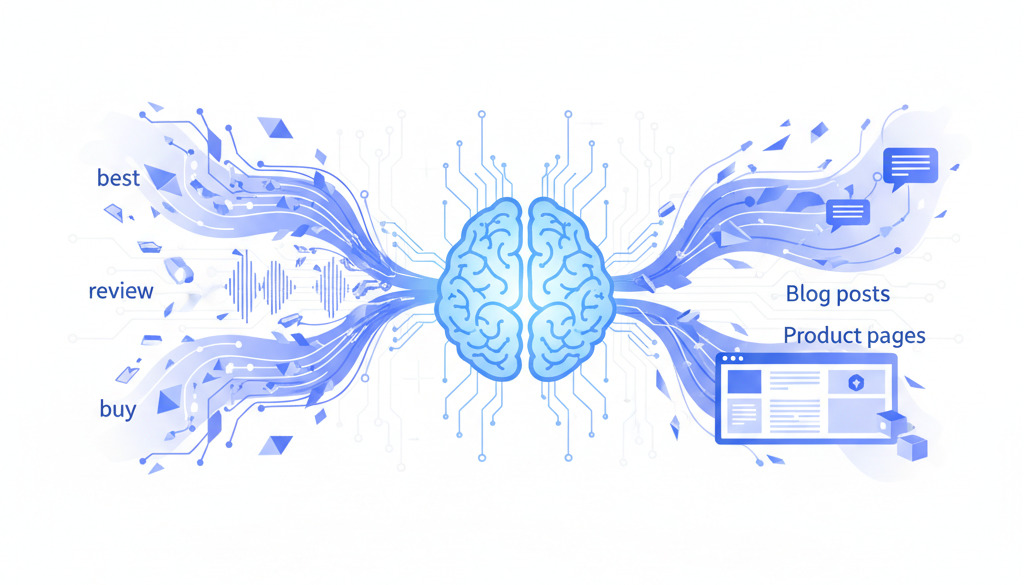
- Commercial Investigation: The user is moving from general research to comparing specific products and brands. They intend to buy soon but are still weighing their options. Queries might include "best," "review," "comparison," or "alternative." Example: "Best waterproof running jackets for men."
- Transactional Intent: The user is ready to make a purchase. Their query is direct and action-oriented, often including words like "buy," "price," "discount," or a specific product name. Example: "Buy Nike Air Zoom Pegasus 40 online."
For a Shopify store, targeting customers in the commercial investigation and transactional stages is paramount, as this is where revenue is generated.
The Challenge of Content Creation for Busy Shopify Owners
If you're a small or medium-sized business (SMB) owner, your most valuable asset is time. Juggling inventory management, customer service, shipping, and finances leaves little room for another full-time job: content marketer. Yet, without a steady stream of fresh, relevant content, your store can become invisible on search engines.
Many Shopify owners face significant hurdles:
- Time Poverty: Simply not enough hours in the day to brainstorm, write, edit, and publish blog posts or optimize product descriptions.
- Lack of SEO Expertise: Understanding keyword research, on-page optimization, and Google's ever-changing algorithms is a specialized skill.
- Creative Blocks: Consistently coming up with engaging ideas that resonate with your target audience is difficult and draining.
- Inconsistent Publishing: Sporadic content efforts fail to build momentum with search engines or create a loyal audience.
Neglecting content marketing isn't just a missed task; it's a missed opportunity.[2] It translates directly to lower organic traffic, reduced brand authority, and, ultimately, lost sales to competitors who are more visible.
What is Buyer Intent AI Content and How Does it Work for Shopify?
This is where technology provides a powerful solution. Buyer intent AI content is content generated by artificial intelligence that has been specifically designed to target keywords and answer questions signaling a user is close to making a purchase.[1] Instead of writing generic articles, the AI focuses on creating content that directly addresses the needs of shoppers in the commercial and transactional phases of their journey.
At its heart, this technology relies on two key AI principles:
- Natural Language Processing (NLP): This allows the AI to understand the nuances of human language, including the context and intent behind a search query.
- Machine Learning (ML): The AI analyzes vast datasets of search queries, user behavior, and successful content to learn what works. It identifies patterns that correlate with high purchase intent and uses that knowledge to generate new content.
For your Shopify store, the process is streamlined: the AI identifies high-value keywords, understands what the searcher wants to know, and then writes human-like, SEO-optimized content—be it a product page, blog post, or buying guide—that perfectly matches that intent.
The Power of AI in Identifying High-Value Buyer Intent Keywords
Traditional keyword research can be tedious and often only scratches the surface. AI-powered tools take this process to a new level, uncovering long-tail keywords and specific phrases that signal strong buying interest. These are often questions your customers are asking right before they decide to purchase.
Examples of High-Intent vs. Low-Intent Keywords
Consider a store that sells high-end kitchen knives. Manual research might uncover a general keyword like "kitchen knives." While high in volume, its intent is broad. AI can dig deeper to find much more valuable phrases:
| Low-Intent Keyword (Informational) | High-Intent Keyword (Commercial/Transactional) |
|---|---|
| "how to sharpen a knife" | "best professional chef knife under $200" |
| "types of steel for knives" | "Wüsthof Classic vs Global G-2 comparison" |
| "what is a santoku knife" | "buy Damascus steel santoku knife" |
AI excels at finding these "money" keywords at scale, giving you a clear roadmap for what content to create to attract customers who have their wallets out.
Tailoring Content to Every Stage of the Buyer Journey with AI
A comprehensive content strategy addresses prospects at every stage of their journey. AI can automate the creation of tailored content for each phase, ensuring you capture interest from the first search to the final click.
Attracting Top-of-Funnel Visitors (Informational Intent)
While not immediately converting, this stage is crucial for building brand awareness and trust. AI can generate helpful guides and how-to articles that position your brand as an authority. For a skincare brand, this could be AI-generated articles like "The Right Order to Apply Your Skincare Products" or "What is Hyaluronic Acid and What Are Its Benefits?"
Guiding Mid-Funnel Decisions (Commercial Investigation)
This is a critical, high-value stage. AI can create detailed comparison posts ("Our Product vs. Competitor X: An Honest Review"), "best of" lists ("The 5 Best [Your Product Category] for 2024"), and in-depth reviews. This content directly assists users in their decision-making process, steering them towards your products.
Converting Ready-to-Buy Customers (Transactional Intent)
When a customer is ready to buy, the content needs to be clear, persuasive, and frictionless. AI can craft highly optimized product descriptions that focus on benefits, not just features. It can also generate copy for landing pages targeting specific "buy now" keywords or create FAQ sections that overcome last-minute objections related to shipping, returns, or product use.
Crafting Compelling Product Descriptions with AI
Your product descriptions are your digital salespeople. They need to be persuasive, informative, and optimized for search. However, writing unique, compelling copy for dozens or hundreds of products is a monumental task. AI can revolutionize this process.
An advanced AI tool can:
- Analyze Product Features: You provide the basic specs (e.g., "100% organic cotton, blue t-shirt, crew neck"), and a single click can transform them into a benefit-driven paragraph.
- Adopt Your Brand Voice: Whether your brand is witty, luxurious, or technical, AI can be trained to write in a consistent tone.
- Optimize for SEO: AI seamlessly integrates target keywords into the descriptions, improving your product pages' chances of ranking on Google.
- Generate Variations: AI can create multiple versions of a description, allowing you to A/B test for conversion or use unique copy across different platforms like Amazon or Facebook Marketplace to avoid duplicate content issues.
Leveraging AI for SEO-Optimized Shopify Blog Content
A blog is one of the most powerful tools for driving organic traffic to a Shopify store. It allows you to rank for keywords that product pages can't target. But as we've established, maintaining a blog is a huge time commitment. This is where AI-driven services can be a game-changer for SMB owners.
For example, services like "More customers from your blog - We write the SEO articles for you" are designed specifically for this challenge. They use sophisticated AI to automate the entire blog creation process. The AI researches topics relevant to your niche and your customers' buying intent, then generates high-quality, SEO-friendly articles. This allows you to build a powerful content engine that attracts qualified traffic from Google without you having to write a single word, freeing you to focus on running your business.

AI-Powered Content for Enhancing the Customer Experience
Buyer intent content isn't just for pre-purchase marketing. It also plays a vital role in post-purchase satisfaction and loyalty. According to Omnisend survey data, nearly one-third of consumers feel that AI makes the online shopping experience less overwhelming.
AI can generate content that improves the entire customer experience by:
- Creating Proactive FAQs: AI can analyze past customer service inquiries to generate comprehensive FAQ pages that answer questions before they are even asked.
- Developing Helpful Guides: For complex products, AI can write user-friendly setup guides, troubleshooting manuals, and usage instructions, reducing returns and support ticket volume.
- Personalizing Recommendations: As seen with Shopify's own AI tools, the system can analyze user behavior to suggest related products through personalized content, increasing average order value.
The "Magic" of AI Content Generation: Speed and Efficiency
The single greatest advantage of AI for a busy entrepreneur is speed. The right tool can accomplish in minutes what would take a human writer hours or even days. This is precisely the philosophy behind modern AI content services. The promise that "our proprietary artificial intelligence writes professional SEO blog articles for your website in minutes - almost like magic" is not an overstatement.
Think about the workflow:
- Traditional Method: Keyword Research (2-3 hours) -> Outlining (1 hour) -> Writing (3-5 hours) -> Editing & SEO Optimization (1-2 hours) = 7-11 hours per article.
- AI-Powered Method: Input Topic/Keyword (5 minutes) -> AI Generation (5 minutes) -> Review & Refine (30-60 minutes) = ~1 hour per article.
This radical efficiency means you can scale your content strategy, respond quickly to new trends, and maintain a consistent publishing schedule without burning out or hiring an expensive agency. Research from Shopify has even shown that merchants using AI assistants for operational tasks can see up to a 40% reduction in time spent on repetitive admin work.
Overcoming Skepticism: Ensuring Quality and Authenticity with AI Content
A common and valid concern among business owners is the quality of AI-generated content. Will it sound robotic? Will it be accurate? Will it reflect my brand? These fears are rooted in older AI technology. Modern generative AI is vastly more sophisticated.
The best approach is to view AI not as a replacement for human oversight, but as an incredibly powerful assistant. The AI does the heavy lifting—the research, the structuring, the initial drafting—while you provide the strategic direction and the final polish.
Your role shifts from writer to editor-in-chief. You guide the AI with a good prompt, and then you refine its output to ensure it aligns perfectly with your brand voice, expertise, and strategic goals. This combination of AI efficiency and human touch produces content that is both high-performing and authentic.
The Growing Community: Why 500+ Businesses Trust AI Content Solutions
The adoption of AI in e-commerce is no longer a niche trend; it's a mainstream movement. The fact that services specializing in AI-driven content are "already used by more than 500 companies" provides powerful social proof. This isn't an untested, experimental technology. It's a proven solution that is actively helping hundreds of businesses like yours grow.
Joining this community means you're not just adopting a tool; you're embracing a new, more efficient way of doing business. The success of these early adopters demonstrates the tangible benefits of AI: higher rankings, increased traffic, and a better bottom line. Their results serve as a testament to the power of integrating AI into a Shopify content strategy.
Getting Started: Your First Steps with AI Buyer Intent Content
Embracing AI content creation doesn't require a massive upfront investment or steep learning curve. You can start small and scale up as you see results. Here’s a simple, actionable plan:
- Start with Product Descriptions: This is a high-impact, low-risk area to begin. Use an AI tool to rewrite 5-10 of your existing product descriptions. Focus on transforming features into benefits and ensuring keywords are included naturally.
- Identify One High-Intent Blog Topic: Use AI to brainstorm a topic based on a "commercial investigation" keyword. For example, if you sell hiking gear, a topic like "The Best Lightweight Tents for Backpacking in 2024" is perfect.
- Leverage a Risk-Free Offer: Many services make it incredibly easy to test the waters. For instance, finding a provider where "your first 5 posts are free" removes any financial barrier to entry. This allows you to experience the full workflow and see the quality of the AI-generated content firsthand.
- Review, Refine, and Publish: Take the content generated by the AI, read it over, and add your personal touch. Tweak a sentence here, add a personal anecdote there, and then publish it.
This phased approach allows you to get comfortable with the technology and see its direct impact on your business.

Measuring the Impact: KPIs for AI-Generated Buyer Intent Content
To confirm that your AI content strategy is working, you need to track the right Key Performance Indicators (KPIs). Look beyond simple page views and focus on metrics that tie directly to business goals:
- Organic Traffic: Are more people finding your store through search engines? Track this in your Shopify Analytics and Google Search Console.
- Keyword Rankings: Monitor your position in Google for the specific high-intent keywords you are targeting with your new content.
- Conversion Rate from Organic Search: This is the ultimate metric. Are the visitors coming from your new content actually buying things?
- Time on Page & Bounce Rate: Are people reading your content? High time on page and low bounce rate signal to Google that your content is valuable and engaging.
- Reduction in Support Tickets: If you use AI to create FAQs and guides, track whether this leads to fewer customer service inquiries.
Tracking these KPIs will provide clear evidence of the return on investment (ROI) from your AI content efforts.
The Future of E-commerce Content: AI as an Indispensable Partner
The integration of AI into e-commerce is only accelerating. We are rapidly moving into an era of agentic commerce, where AI agents may shop on behalf of consumers, researching and comparing products autonomously. As this new model gains traction, having content that is easily understood and favored by AI will be critical for survival.
Your content needs to be structured, data-rich, and explicitly answer the questions that both human shoppers and AI agents will ask. Businesses that build a strong foundation of AI-generated, intent-driven content today will be in the prime position to succeed tomorrow. AI is not a fleeting trend; it is becoming a fundamental layer of the e-commerce infrastructure.
Conclusion: Elevate Your Shopify Store with Intelligent Content
As a Shopify business owner, your goal is to connect your great products with the right customers. In today's digital marketplace, the most effective way to do this is with a smart, scalable content strategy. AI-powered buyer intent content offers a direct path to achieving this. It saves you invaluable time, targets customers who are ready to buy, boosts your visibility on Google, and enhances the overall customer experience.
The technology is no longer out of reach or reserved for large corporations. It's accessible, affordable, and designed for busy entrepreneurs like you. By embracing AI as your content creation partner, you can stop struggling to keep up and start building a powerful, automated engine for growth. Take the first step today and discover how intelligent content can transform your Shopify business.
Frequently Asked Questions
1. Will Google penalize my site for using AI-generated content?
No. Google's official stance is that they reward high-quality content, regardless of how it is produced. Their focus is on content that demonstrates expertise, authoritativeness, and trustworthiness (E-E-A-T). As long as the AI content is accurate, helpful, and serves the user's intent, it is perfectly acceptable. The key is to use AI to create valuable content, not to spam search results with low-quality pages.
2. How much human editing is required for AI content?
This depends on the quality of the AI tool and the specificity of the topic. For a well-developed AI service, the content may require only minor edits—perhaps 15-30 minutes of review to add unique brand insights, check facts, and adjust the tone. The AI handles 80-90% of the work. You should always plan for a human review step to ensure the final product meets your quality standards.
3. Can AI really understand my niche product and brand voice?
Yes, modern AI systems are surprisingly adept at this. You can "train" the AI by providing it with examples of your existing content, a style guide, or detailed prompts that describe your brand's personality (e.g., "Write in a professional yet friendly tone," or "Use simple language and avoid technical jargon"). The more context you provide, the better the AI will be at matching your unique voice and writing knowledgably about your products.
4. What is the difference between using a tool like ChatGPT and a specialized AI content service?
While general-purpose tools like ChatGPT are powerful, a specialized service is often pre-configured for a specific task, like writing SEO blog posts with buyer intent. These services often integrate keyword research, SEO analysis, and content structuring directly into the workflow, producing a more complete and optimized article "out of the box." They are designed specifically for the needs of a business owner, aiming for efficiency and tangible marketing results.
5. Is AI content creation expensive?
It is significantly more cost-effective than traditional methods. Hiring a freelance writer can cost anywhere from $100 to $500+ per article. A full-time content manager is a major salary expense. AI content solutions are typically offered as a monthly subscription at a fraction of that cost, and many, like those mentioned in this article, offer free trials or introductory plans (e.g., the first 5 posts free) to make it accessible for any budget.
6. How can I ensure the factual accuracy of AI-generated content?
This is a crucial part of the human oversight process. While AI has access to vast amounts of information, it can occasionally make errors or "hallucinate" facts. It is essential to fact-check any specific data, statistics, or product claims before publishing. Use the AI-generated text as a foundation, but always verify critical information against reliable sources, especially when discussing technical specifications or making direct comparisons.
Keep reading
Hand-picked guides that go deeper — open the one you need next:
- Shopify E-commerce SEO: The Complete 2026 Guide
- Skyrocket Shopify Sales: AI & Buyer Intent SEO
- Shopify Sales Surge: Driving Traffic with AI-Powered Blog SEO
- Automated Content Publishing for E-commerce: Drive Sales on Shopify
→ Read the full Shopify & Ecommerce guide